Summarizing the good, the bad, and the outright weird since inauguration weekend
Author: Kara Hurvitz
Hi there! If you're reading this, you're probably wondering who I am and why you should listen to me. (It's a fair cop.) So here's a little about me:
I'm an advocate, educator, and activist with degrees in law and social work. By day, I help people access needed health care and health care coverage. By night, I fight crime--nah, just kidding; I write the NNR and related essays.
Why the NNR? Well, I want to do everything I can to help folks stay informed, connected, and empowered during this difficult time, and this project lets me put work I already do to good use. Plus, I get to snark about the news and current administration. Everyone wins!
Photo by me, courtesy of the Audubon Butterfly Garden and Insectarium in New Orleans, LA
We live in a big country, and that means regions can have a lot of particularly disparate experiences. For example, did you know that places in the American South experience lawn crayfish? That’s what it sounds like, by the way; it’s an invertebrate related to the common crayfish that lives in your lawn. Many people from the North, myself included, look at that and say “Why is my seafood dinner hanging out next to my begonias?” But in the South, that’s just a thing.
I mention this because we’ve had a solid week now of the Washington Post reporting on the story that Roy Moore, the Republican special election candidate for the Alabama Senate seat vacated by Jeff Sessions, solicited sexual acts from multiple underage women when he was an ADA in his thirties. And much like the lawn crayfish, some prominent people in the South have accepted and defended Moore doing his squirmy, unsettling thing, while all of us in the metropolitan North demand to know what on earth is going on. It’s a predictable, regional mess that can have real life consequences for us all, so I’m writing a bit more about it today. Here are some examples and analyses of the past week’s horrorshow defenses, which have pretty much been The Worst Game of Handmaid’s Tale Bingo:
“There’s nothing wrong with the story as reported.” The most prominent variant on this claim came from Alabama State Auditor Jim Zeigler, who compared Moore’s actions to Mary and Joseph in an interview with the Washington Examiner. It reflects one of the most important underpinnings of this entire thing: as locals have started saying, they already knew he was preying on teenagers. In the incredible political atmosphere of 2017, grass roots deconstructionist Republicans feel safe simply stating that molesting children is normal per the Bible. (Although in this case, I’m not sure I’d point to a famous instance of a virgin birth to prove my point about sexual misconduct.)
“It was so long ago, and people shouldn’t be held accountable for mistakes made in their youth.” Never mind that he was in his thirties, and a licensed attorney at the time of all four allegations; that isn’t relevant. Jim Zeigler, the guy responsible for the Joseph and Mary quote, even included a messed up Romeo and Juliet argument that Moore simply habitually loved younger women in his youth, citing the fact that his current wife of 35 years is 14 years his junior. (As if marrying a young adult when you’re an established professional, whom you make your own legal secretary, creates an equitable relationship rather than an additional lever for control.)
“If this is true, it’s reprehensible.” This one is particularly insidious, and it’s one of the biggest reasons I think this story should not have been published. Republican officials know they can say this with abandon to thread the needle, because in Alabama, the statute of limitations on childhood sexual abuses is long gone. We are never going to have “more facts,” because there will never be a trial, which means everybody in the Tea Party faction of the GOP who doesn’t live in Alabama can get away with this scandal’s version of offering “thoughts and prayers.”
“This was in some way the teenagers’ fault.” I was waiting for this one in particular to show its ugly head from the moment I read this story, for obvious reason. And sure enough, we have an Alabama state rep calling for the women who spoke to the Post to be prosecuted, saying that they enabled Moore by not reporting him if these stories were true. Keep in mind that Moore was an ADA when these allegations would have happened. Would you go tell the police that their colleague tried to illegally get sex out of you, or your daughter? Relatedly, I will be extremely surprised if these women aren’t doxxed and threatened with rape or death, which is Reason #2 this story should not have been published in this timeframe.
“It’s too late for you to interfere; he’s already our candidate and you can’t make us remove him.” This one is the biggest crayfish in the yard, and it has the unfortunate credibility of being absolutely true. It’s too late for the RNC to remove him from the ballot and Alabama officials have no desire to remove Moore for something they already knew about and probably condone. In fact, we’re already seeing Alabama Republicans respond to pressure at this stage by mobilizing their local base. Even worse, when it’s known that Luther was the favored establishment candidate, and the establishment tries to intervene past when it’s effective, local politicians are accurately stating that there was an attempt to tamper with the elective process. The Tea Party base is not noted for favoring truth, but that doesn’t mean they don’t respond to it when it’s in their favor.
Basically, this was a gross miscalculation that assumed Alabama natives would have the same rules of conduct we can expect in Washington, DC — a faulty and potentially dangerous assumption. I get why the Post, and possibly the establishment GOP, thought they could ride the tide of sexual harassment allegations and voting referenda from Tuesday to damage Moore’s chances in a close special election. But those things didn’t happen in Alabama — the location that elected Jeff Sessions over and over. It’s not an area known for listening to women’s voices. I don’t know why they thought that living in Trump’s post-decency political realm would make that any better.
Ernest Blaikley [Public domain], via Wikimedia Commons
Well, okay, this week wasn’t the worst we’ve ever seen — but it’s been a deeply surreal (and intermittently horrifying) week nonetheless. Between two deadly attacks in New York and Texas, the ill-advised DNC infighting, and the GOP Tax Cut Opus, we’re sort of cruising along on the Why Is This Reality Highway. But that’s better than stewing in Darkest Timeline juices literally all week, so I guess I’ll take it.
Standard standing reminders apply: I am no journalist, though I play one in your inbox or browser, so I’m only summarizing the news within my area of expertise. This week’s news contains some detailed analysis that’s outside my expertise — I’m a lawyer, not a tax person! — but all offroad adventures are marked with an asterisk. Okay, I think that’s about it for the disclaimers. Onward to the news!
Constitutional Crisis Corners:
For a second week in a row, the Russia Collusion Investigation remains the biggest news of the week. We saw a lot of different interrelated developments:
Sessions Probably Caught in Perjury (Again).* It’s a sad state of affairs when we’re discussing the Attorney General’s second instance of lying to a tribunal, but here we are. Sessions said repeatedly under oath that he had no knowledge of anyone on the campaign meeting with Russian officials, but George Papadopoulos testified that he had let Sessions as well as Trump know — and Trump apparently tweeted photos of that meeting at the time that it happened, so we know all three individuals were present. And yet another foreign policy adviser, Carter Page, testified that he met with Russian officials as well. Unsurprisingly, Senate Democrats want to interview him again given this week’s bombshells.
And of course, we also saw several Threats toHuman Rights this week:
Divergery Lottery. Despite barely being able to pronounce the program, Trump had a lot to say about the Diversity Visa lottery program this week after a terrorist attack in New York City. In a tweet that literally CCed Fox and Friends, Trump announced that he “wanted merit-based” immigration instead of “democrat lottery systems.” This reflects a, shall we say, imperfect understanding of how the diversity visa system actually works; the program underpinnings were created in the 1960s in response to older quota systems and the system does have rigorous vetting already built into the process. Also, and most importantly, Trump can’t scrap the current diversity lottery program because it was created by Congress twenty-seven years ago (which, by the way, was during a Republican majority and a Republican presidency, not that it matters). Presidents don’t have constitutional authority to scrap laws created by legislatures, however much they might pretend otherwise.
Disturbing “Justice” Statements. Trump also had a lot to say about people’s criminal defense rights, by which I mean he thinks nobody has any. He wanted the suspect of Tuesday’s terrorist attack, a lawful permanent resident of the United States who committed crimes on United States soil, sent to Guantanamo Bay because — and I quote — “we … have to come up with punishment that’s far quicker and far greater than the punishment these animals are getting right now” (emphasis mine). I sincerely hope everyone reading this is already aware, but any time a formal statement from public officials involves calling human being ‘animals’ it is not a great sign for civil rights. After he walked that one back, Trump moved onto saying that the suspect in custody should be put to death, which is troubling on multiple fronts because the suspect hasn’t had a trial yet (and, ironically, Trump’s statements might make it harder for prosecutors to do their jobs). All these statements are, of course, on top of the various other fascist things Trump has said in this week and past weeks, which include everything from trying to block the Russia investigation to demanding criminal investigation of political opponents. It’s… not a great look for any administration, let alone one with a 59% disapproval rating.
‘Give Me a Lawyer Dog’. Trump’s blatant disregard for our justice system is made even more concerning by a slip opinion concurrence from the Louisiana Supreme Court this week; the concurrence was on a decision to not to hear the case, so this was presumably this judge’s way of getting his $0.02 in even though the court wasn’t going to write anything with legal value. The concurrence stated that a defendant saying “Give me a lawyer, dog” did not count as invoking his sixth amendment right to an attorney because — and I quote — “defendant’s ambiguous and equivocal reference to a ‘lawyer dog’ does not constitute an invocation of counsel.” Though in this particular instance there were repugnant charges involved, I seriously cannot stress enough how little that should matter when we’re discussing someone’s constitutional right to ask for an attorney while answering police questions. And claiming that he might have been asking for a canine who has passed the bar is just insulting to the rest of us; it’s like the judge isn’t even trying to hide that he’s giving the questioning officers blatant cover. Do you want a police state, Louisiana? Because this is how we get police states.
Your “Normal” Weird:
DNC vs HRC. Okay, y’all. We have multiple major elections this upcoming Tuesday, including two gubernatorial races, and the Virginia race in particular is reported to beparticularly closeand nasty. So hopefully the DNC is mobilizing to support the Democratic candidates who are running in these important interim elections, right? LOLNOPE, they’re too busy erroneously crucifyingHillary Clinton because she formed some fundraising committees with the DNC and may have therefore gotten strategic advantage in 2016! Because that super matters over a year later, and our fascist administration definitely won’t latch onto thatto call for the arrest of people you later announce are law-abiding citizens after all. Thanks, Donna Brazile! Maybe you should let Tom Perez take things from here.
Rick Perry’s Strange View of Lightbulbs.* Rick Perry made the baffling claim this week that fossil fuels help with sexual assault because of the “light that shines. . . [of] righteousness” on the act. Though he was specifically talking about power in Africa, and there is some evidence to suggest that bringing power to developing countries can lower instances of assault, that still doesn’t explain why fossil fuels would be better or more tenable than other forms of electricity. As my researcher put it: “I guess if conservatives think that fossil fuels shine with the light of righteousness, that explains a lot about why they prefer it over greener energy.”
Mercy, Mercer.* News broke this week that business tycoon and Trump patron Robert Mercer is stepping down from his hedge fund and selling his share in Breitbart News. Though this likely at least in part due to increasing investor discomfort with supporting an actual white supremacist, it may also have something to do with the $6,800,000,000 the company owes the IRS in taxes (and that’s not a typo; yes, that number really does say six point eight billion). At any rate, it will be interesting to see what other shoes drop from Renaissance from here.
The Bad:
Violence in New York and Texas. This week saw two instances of mass murder in the United States, killing over 30 people total. On Tuesday afternoon, a man in a rented truck plowed into a crowded Manhattan bike path, killing eight people and injuring eleven more seemingly at random. ISIS eventually claimed credit for the attack, but ISIS would claim credit for an F line signal delay if they thought New Yorkers hated it enough, so who knows whether they were actually involved. (Trump nonetheless is threatening them like they were involved, and also initially threatened to send the suspect to Guantanamo Bay). Further compounding this tragedy, on Sunday morning, a suspect walked into a small Southern Baptist church in Sutherland Springs, Texas and opened fire on praying congregants, killing twenty-seven people and injuring over twenty more. (The suspect was later found dead three or four miles away, and police are currently investigating whether the wounds were self-inflicted.) Though the New York attack is being attributed to terrorism, the Texas attack appears to be rooted in domestic violence, as the perpetrator’s wife’s family attended services there and had been previously threatened by the gunman several times.
CHIP On Our Shoulders. The House did pass a bill funding the Children’s Health Insurance Program this week, but it has a lot of issues and the Senate is having none of it. More specifically, the bill is yet another attack on the ACA; it creates funding for CHIP by shortening the grace period for ACA enrollees and dipping into an ACA public health fund. It seems likely that the Senate will come up with a different plan entirely, but this of course creates uncertainty again for the CHIP program — and in the meantime, nearly nine million kids may or may not run out of funding for their healthcare. So that’s not awesome, to say the least.
The Good:
MA Bans Bump Stocks. My home state of Massachusetts made the news this week by passing the nation’s first law banning use, sale, and ownership of bump stocks, which were used in the Las Vegas shootings to turn semi-automatic weapons into makeshift automatic firearms. Though I’ll be the first to acknowledge that Massachusetts gun laws create some unique prosecutorial issues and are far from perfect, I also feel strongly that no one should have the capacity to build their own automatic weapons, so I’m pretty okay with this development.
Feeding Puerto Rico. Chef José Andrés, who leads a food security activist group called World Central Kitchen, has been undertaking extensive efforts to make sure Puerto Ricans have food. At the time that I write this, Mr. Andrés’s kitchen network has served over 2.3 million meals and sandwiches to the residents of Puerto Rico in a four-week period — which would be a very impressive number even without the power issues present there. The organization relies heavily on food trucks for door-to-door distribution, bringing food to remote locations on an island with damaged infrastructure. Efforts are now winding down, but presence will remain on the island in more remote locations for the foreseeable future.
Rogue Twitter Folk Hero. A random and recently-let-go Twitter employee won hearts this week by deleting Trump’s account on their way out the door, though it took Twitter quite some time to admit that — they initially chalked the issue up to “human error.” Predictably, Trump’s followers were incensed and the rest of Twitter had a field day. If I ever have occasion to meet this employee, I’m totally going to buy them a thank-you coffee.
And that’s what I have this week. We could go on either direction from here, and I personally am going to keep fingers crossed for a better news week next week. But in the event that it’s terrible, I’ll still be here, snarking all about it!
Happy Manafort Monday, y’all! But don’t let the name fool you, because the real news of the week is that I got you news of an unsealed Papadopoulos conviction for Halloween. I super hope you like it, because we have a strict No Return policy here on game-changing secret convictions.
Standard standing reminders apply: I am no journalist, though I play one in your inbox or browser, so I’m only summarizing the news within my area of expertise. This week’s news contains some detailed analysis that’s outside my expertise — I’m a lawyer, not a uranium miner! — but all offroad adventures are marked with an asterisk. Okay, I think that’s about it for the disclaimers. Onward to the news!
Constitutional Crisis Corners:
The Russia Collusion Investigation is, without a doubt, the biggest news of the week:
Mueller Indictments Monday. The first two indictment lists have been issued to former Trump campaign staffers Paul Manafort and Rick Gates, totaling twelve indictments between them (mostly relating to money laundering and tax fraud). Both Manafort and Gates have turned themselves in and pled not guilty on all counts. (Fun fact: Manafort is actually facing investigations on three differentfronts right now.) But the biggest news of the day is that former foreign policy adviser George Papadopoulos secretly pled guilty a few weeks ago, and both the charges and the deal are really, really significant. The charges were lying to the FBI about collusion with Russia — I believe the words “dirt on Hillary Clinton” literally appear multiple times in the documents. And the plea deal itself provides that “the Government agrees to bring to the Court’s attention at sentencing the defendant’s efforts to cooperate with the Government, on the condition that your client continues to respond and provide information regarding any and all matters as to which the Government deems relevant” (emphasis mine). In other words, “as long as he tells us literally everything we’ll make sure he never goes to prison.” Manafort may be the bigger name, but Papadopoulos is the bigger story for today. (If/when Mueller manages to flip Manafort, though, that will definitely change.)
Uranium What Now?* In a (probably vain) attempt to distract from news that Mueller was about to announce indictments, the Trump administration began trying to claim that actually Hillary Clinton was colluding with Russians during the 2016 election (not Trump). As far as I can tell, this involved conflating the fact that the Clinton Foundation received a donation from some people who are tangentially tied to a uranium mining company and the fact that Bill Clinton was once paid by Russia for a speaking engagement in Moscow. It’s all… pretty flimsy at best. I recommend reading the Washington Post demystification article, because the whole thing is attenuated and ridiculous.
Bill Browder Appreciation Hour.* The other Russia-related news of the week is that Bill Browder,a famous critic of Putin’s human rights abuses who disclosed the horrors that led to the Magnitsky Act,was briefly barred from the United States this week. Though he had originally been granted a visa application, U.S. officials revoked it when Russia had him placed on an Interpol list — and yes, that would be the same Russian officials on whom Browder is famous for blowing the whistle. Browder did eventually get his visa reinstated, and the administration is maintaining that the first decision was an automatic response to the listing. But since it was changed after a massive bipartisan outcry, it’s hard to tell if that was accurate. At any rate, it appears to be mostly fixed now, and it’s probably a good thing that happened before the Mueller news broke.
And honestly, the Russia news can’t come soon enough, because we also saw more Threats toHuman Rights this week:
“An Immoral Travesty.” That is how Diane Feinstein described Customs and Border Patrol’s actions regarding a ten-year-old girl with cerebral palsy, and she frankly isn’t wrong. The story has gained national attention for its extreme facts: CBP stopped an ambulance at an immigration checkpoint, and when they learned there was an undocumented person inside, tracked ten-year-old Rosamaria to the hospital, apprehending her immediately after she received emergency medical surgery. Putting aside the obvious health implications of forcing an ambulance taking someone to an emergency room through a checkpoint, which frequently can take a very long time, the story illustrates what a strong disincentive immigrant families experience to seek medical help in places with heavy CBP presence.
Somehow We’re Still Talking about the NFL.* We also had a bit more ridiculous anti-protest news in the form of a comment from a Texans owner Robert McNair that “we can’t have inmates running the prisons.” Setting aside what that suggests he thinks about the entire business of professional football, it’s obviously a very problematic statement, and he’s now apologized for it twice. Also, and more importantly, that particular outburst was sparked by conversations in which the NFL decided not to have an anthem mandate, so at least the NFL is still approaching the issue in a nuanced way.
Republican Resistance Grows.* A growing number of retired or retiring prominent Republicans — such as George W. Bush, John McCain, Bob Corker, and Jeff Flake — have all spoken out quite bluntly against Trump in the past week or two. Several of these figures will continue to hold a position of power for over a year, and some fellow Republicans with no obvious retirement plans are starting to react — which may be a reflection of the growing unease within the party that Bob Corker describes generally. Overall, we might be witnessing a shift away from Republican cooperation with the President’s agenda, and it’s worth watching carefully as a result. (The Washington Post also has an interesting piece on what Corker and Flake’s impending retirements might mean for the Senate.)
Refugee Decisions Quietly Made. Without much fanfare, the very last of the former travel ban was mooted this week, with the Trump Administration letting the refugee provision expire (and the Supreme Court dismissing the corresponding case accordingly.) But there’s another 90-day window of review for 11 countries facing “higher scrutiny,” which means refugee applications from those countries will be reviewed on a case-by-case basis; this is in addition to the incredibly low 45,000 cap set for total refugee resettlement in fiscal year 2018. The Trump administration is refusing to even name the 11 countries, which is really unusual; I can’t imagine this is the end of the travel ban legal battles.
The Bad:
401k Shuffle. Despite repeated promises from Trump, Congress is considering limiting 401k retirement contributions as part of its tax reform package. This is odd, not only because it’s unpopular with Wall Street, but also because it appears to discourage saving for retirement at all — and we already have problems with people saving too little. The 401k saga is likely unfolding the way it is because it’s an obvious way to offset tax cuts, and probably ultimately will result in more incoming government money than other options. But if everybody stops saving for retirement, it has the capacity to start costing the government large amounts in the long-term unless Medicare and social security are dismantled as well, because those are entitlement benefits — once people reach a magic age, they’re all allowed to ask for it and a lack of retirement planning means they’re more likely to need it. This is sort of like saying “we need people to buy our candy bars, let’s make it harder to pay for dental visits” and then hoping somebody else has to pay for all the dentures.
EPA Blocked Its Own Scientists from Speaking. The headline kind of says it all on this one; the EPA canceled its own scientists’ presentation at a conference on climate change. When pressed for an explanation, the agency said that the scientists were attending; they just wouldn’t be presenting because “it wasn’t an EPA conference.” But it sounds like everyone attending understood what was really happening; other scientists (fairly) described it as “a blatant example of . . . scientific censorship.”
Too Big to Sue.* The Senate voted this week to repeal a landmark Consumer Federal Protection Bureau regulation that limited mandatory arbitration clauses in bank account agreements. For those of you reading this who haven’t tangled with mandatory arbitration clauses before, they are a common corporate tactic to limit suits and force people through a “negotiation” process when they have grievances. It sounds good on its face, except that the deck is often stacked in the company’s favor because they have a relationship with the arbiters and the consumers don’t. In fact, it is because these clauses heavily advantage businesses and disadvantage consumers that the newly-repealed law was put in place in July in the first place; though Republican talking points suggest otherwise, the regulation merely required banks to draft user agreements that allowed consumers to retain the option to organize class action lawsuits. Adding insult to injury, it was a 50–50 tie, meaning that Pence cast the tiebreaking vote.
Opioid Not-Actually-An-Emergency. Despite earlier promises to the contrary, the Trump administration failed to declare an opioid national emergency this past week. What they did instead was declare a “public health emergency,” which sounds similar — except there’s no money attached (as there would be for a national emergency), because the public health fund is empty. And Trump appears to think we can solve this by Just Saying No. Basically, it’s the difference between “The house is on fire, let’s call firefighters” and “The house is on fire, let’s call my buddy Steve.” Except in this scenario, Steve thinks you can put out house fires by telling the fire to stop burning things.
Budget Proposal Movement. The House passed last week’s budget proposal by a very narrow margin this week; just like in the Senate, every single Democrat voted against it. Though the budget vote does not create fully-formed law — they still need to write the actual tax reform — this is a concrete first step, and that is not necessarily a good thing. But as mentioned last week, it might prove to be the bribe that makes the Republican party actually move to oust Trump, so it might be a mixed thing. We’ll have to see what happens from here.
GAO is AOK. News broke this week that the GAO will be investigating the voter fraud commission at the request of prominent Democrat Senators Michael Bennet, Amy Klobuchar, and Cory Booker, who wrote a letter asserting that the commission appeared designed to perpetuate voter suppression. The office warned that appropriate staff won’t be available to investigate for another five months, but it’s promising that the office accepted the request at all — let alone within a week of the request.
Trans Military Rights Preserved (For Now). A DC federal court granted a preliminary injunction today that pausing Trump’s order banning trans military service, noting that it constituted an impermissible removal of due process for a protected class. This is exciting both because it pauses the order and because a preliminary injunction requires the plaintiffs to show that they’re likely to win their case — so the court was essentially opining that this order was unconstitutional. I’ll be very interested in seeing what happens with this decision.
And that’s what I have for now! But the news is still moving very quickly, so daily news summaries like WTFJHT remain a very good idea for the foreseeable future. We tend to see a rough week after we get inspiring news, because this administration does not take lumps gracefully — and some are still worried that Trump’s about to fire Mueller — so let’s batten down the hatches and prepare for more storms. And hopefully we’ll meet under sunny skies again next week!
By Internet Archive Book Images [No restrictions], via Wikimedia Commons
I saw an article that described this week as a “terrible week for Trump.” Needless to say, as a general rule, a bad week for Trump is a good week for the rest of America, and this week appears to be no exception. Though we’re not out of the woods by any means — in fact, some really concerning things did happen this week — we reached a bit of a summit in the slow slog back to a healthy country. It’s nice to have some news to report this week that’s actually good.
Standard standing reminders apply: I am no journalist, though I play one in your inbox or browser, so I’m only summarizing the news within my area of expertise. This week’s news contains some detailed analysis that’s outside my expertise — I’m a lawyer, not Facebook staff! — but all offroad adventures are marked with an asterisk. Okay, I think that’s about it for the disclaimers. Onward to the news!
Constitutional Crisis Corners:
The Russia Collusion Investigation was pretty all over the map this week — the short version is that the investigation is working, kind of, but what we’re learning is not awesome:
Best Fake Russian Propaganda in Texas. A surreal story hit this week about an extremely effective Russian propaganda machine on Facebook that was successfully convincing Texans they wanted to secede from the country. The group had over 225,000 followers and was only taken down last week, which is kind of horrifying. Perhaps most importantly, they reached out to a real, existing Texas secessionist group and asked them to participate in anti-Hillary rallies during the 2016 election. So that’s…. a thing that happened and fooled almost a quarter million people.
Social Media to Testify. And speaking of both social media and testifying, Twitter and Facebook are both scheduled to testify before congressional committees on November 1. (Well, their general counsel, at any rate; trying to get the apps to testify probably wouldn’t be very fruitful!) It will be interesting to see what happens with their testimony, to say the least.
This has really not been a good week on the Threats toCivil Rights front either:
Immigrants Need Not Apply.* Among other challenges faced by lawful permanent residents who immigrate to this country, this administration recently implemented challenging delays to service in the military and a full bar to service for some branches. They are no longer allowed to enlist in some part-time branches, and cannot begin basic training before lengthy background checks are completed. Because military service opens the door to many types of opportunity and career advancement in this country, policies that bar people from enlisting have a variety of collateral consequences. Simply put: It’s one more form of discrimination on the pile.
Your “Normal” Weird:
The Trump Reality Show Continues. I’m not going to dwell, simply because the most sensationalist chest-thumping seems like a vacuous distraction rather than a credible threat. But this week Trump continued the ongoing reality show, issuingmorethreatsto McCain after the latter criticized his bonkers foreign policy and badlybotchingcondolencecalls after several soldiers were lost in Niger. Adding to the surreal reality-show feel of current politics, Dubya alsosaidhis piece about Trump (although he declined to mention him by name at any point). It’s been strange, y’all.
Tax Reform News.* The Senate passed a tax reform initiative this week along partisan lines, squeaking out the bare minimum of votes needed despite bloc opposition from Democrats (and Rand Paul). I place this under the ‘weird’ column rather than the ‘bad’ column for several reasons: First of all, few people have even seen the bill, despite its success on the floor; as this first fact suggests, the bill is being rushed for a variety of reasons (which I can only hope to speculate about, since the Hill is a such bizarre quagmire right now). But they are using the reconciliation process — which you may remember from the summer’s ACA Repeal Greatest Hits — to pass Go and collect their $200 without working with Democrats. And that process is inherently kind of tricky and complicated, which makes it odd that they are trying to rush and also use it. Senator Corker’s recent outbursts have caused some pundits to speculate that tax reform is the only thing keeping the GOP on board with Trump’s egregious and dangerous Presidency; if they’re right, the tax reform efforts are also odd because they’re being treated like a final hurdle to impeachment.
The Bad:
9/11 Executive Order Part 2. With very little fanfare, Trump signed an executive order on Friday that piggybacked on a 2001 order responding to 9/11. The 2001 order declared a state of national emergency in response to recent terrorist attack and granted the President power to recall retired troops into service. Trump’s order also declares a state of emergency, Because Reasons, and allows him to recall up to 1,000 retired Air Force personnel, because the branch apparently has had staffing issues for some time. The order’s vague reference to an ‘emergency’ is very concerning, given that no obvious terrorist-based emergency has happened; some readers are also interpreting it to permit recall of other branches as well. (And if you’re noting the staffing shortages referenced in this section and asking yourself why this administration is also limiting who is allowed to serve based on citizenship, I too am asking that.)
Courts are Having None of this Nonsense There were several very prominent court wins this week, and they are all very edifying! Federal district courts in both Hawaii and Maryland have suspended the new travel ban, finding that the changes to the order do not overcome the issues that have plagued the ban since its inception. (And if you’re confused about the ridiculous number of versions of this ban, ABC has your back with a helpful summary and timeline.) But we also heard from the federal district court judge who was handling Joe Arpaio’s case; she held that his pardon does not vacate his conviction. The language of that four-page opinion is satisfyingly crisp; I particularly enjoy her note that the pardon “does not blot out guilt.”
And that’s what I have; some good, some bad, overall a bit less horrifying than normal. But the news is still moving very quickly, so daily news summaries like WTFJHT remain a very good idea for the foreseeable future. Let’s see if we can keep this streak going!
Still Life — A Boot on a Newspaper, by Ernest Blaikley [Public domain], via Wikimedia Commons
Preparing a draft on Sunday night, I turned to my editor and unironically said, “Oh wait, I’m not done with the Constitutional Crisis section yet, because I need to add a note about Larry Flynt under the Russia Investigation header.” As a friend of mine observed to me today, “This may or may not be the darkest timeline, but it’s sure as hell the weirdest.” (Although my money’s on both being true, for the record. I recommend comfort foods.)
Standard standing reminders apply: I am no journalist, though I play one in your inbox or browser, so I’m only summarizing the news within my area of expertise. This week’s news contains some detailed analysis that’s outside my expertise — I’m a lawyer, not a firefighter! — but all offroad adventures are marked with an asterisk. Okay, I think that’s about it for the disclaimers. Onward to the news!
Constitutional Crisis Corners:
The Russia Collusion Investigation was unfortunately pretty stymied this week:
Social Media Scarpering. This week we learned that Twitter deleted data that would be relevant to the Russia investigation, which is frustrating to say the least. But there was evidence that Facebook isn’t really cooperating either, and took down thousands of posts that could have helped the investigation to minimize their role. So, uh… thanks, guys. That was helpful.
Yes, That Larry Flynt Ad Really Happened. You didn’t have a Nyquil-induced fever dream; Larry Flynt really did take out a full-page ad in the Washington Post this week offering $10M for “information leading to the impeachment and removal from office of Donald Trump.” Putting aside how fascinating it is that the guy who literally runs Hustler finds Donald Trump distasteful, I haven’t yet heard anything about leads from the ad. I promise I’ll keep y’all posted.
This has really not been a good week on the Threat toFree Speech front:
It’s Disgusting, All Right.* Trump threatened to take away NBC’s license over a story they ran this week, saying it was “frankly disgusting” that they are allowed to report things freely. Then he doubled down, saying that licenses “must be challenged and, if appropriate, revoked.” The FCC had nothing to say about this veiled threat, which is less than comforting. We need to be calling our reps about this, because it’s a serious threat that we can’t ignore.
SCOTUS Dismisses the Travel Ban Case. The Supreme Court dismissed the travel ban case this week, saying that it was moot because the original terms had expired. Without going too far into the weeds, needless to say, I don’t agree with this assessment when there’s a new, more permanent form of the (arguably same) travel ban in effect as I write this. There’s still a related matter pending, but it seems likely it will be dismissed as well. Though it seems likely there will be a legal challenge to the third travel ban, this is a frustrating and vaguely strange setback.
The Wall of the Deal. Trump is still trying to use Dreamers as a bargaining chip to get his wall funded, which is pretty much the literal opposite of a clean DREAM Act and as a result was summarily dismissed by Democrats about thirty seconds after he asked. Then he announced that maybe he’ll push back the March 5 deadline if nobody will cut a deal with him. His negotiation tactics are like a surreal version of Getting to Yes where you just spin a wheel and offer whatever comes up when it stops. Meanwhile, Senator Thom Tillis has introduced a bill that… might be making traction? It’s hard to say, honestly, with Trump spinning his Art of the Deal Wheel in the background every five minutes, but it’s worth watching.
Contraception Mandate Narrowed. At the end of last week, Trump signed an executive order stating that employers no longer have to cover contraceptives under the ACA if they have religious objections. This change could cause hundreds of thousands of women to lose medical coverage, which creates considerable medical risk despite the administration’s claims that oral hormones and other contraceptives aren’t safe. Also, because apparently nobody covering this has bothered to point it out, plenty of people take oral hormones as medication for actual medical ailments, and the entire point of employer-based insurance is to cover people’s medical costs.
Bombs in the ACA Marketplace. Remember how Trump has been threatening to stop paying subsidies for like a billion years now? This past week, he formally announced he was doing exactly that, effective immediately. The timing of this is pretty rough; it’s only a couple of weeks before the enrollment window was set to open, and it comes on the immediate heels an executive order to allow alternative health plans that provide less coverage under the current legislature. It’s possible this is a ploy to get Democrats to amend the ACA, but in the meantime the one-two punch has a lot of capacity to screw up the marketplace and the ACA more generally, at least in some states. We’ll need to continue to call our reps to try to get bipartisan infrastructure in place, and also watch the lawsuits on this carefully — see more information on the latter below.
Iran Certification News.* As forecast earlier in the week, Trump disavowed the Iran nuclear agreement, but stopped short of leaving entirely. Instead, he told Congress to alter the deal, threatening to leave at a later date if changes aren’t made. We’ll need to watch what our reps do with this as well, but it’s a lighter blow than we were led to expect, and frankly I’ll take whatever I can get at this point.
The Good:
ACA Lawsuits. The silver lining to this past week’s ACA shenanigans is that there is already a growing pile of lawsuits filed on both executive orders and the subsidy announcement. The ACLU, Washington Attorney General, and California Attorney General are all suing Trump over rolling back the contraceptive mandate, arguing (probably correctly) that it violates the Establishment and Equal Protection clauses of the Constitution. Meanwhile, eighteen states and the District of Columbia are suing over the subsidies, seeking an injunction that would force the President to keep paying them. The National Governors’ Association issued a statement on the topic as well, indicating that they will be coordinating with Congress directly to facilitate a bipartisan fix on the subsidy issue. There are clearly a number of moving parts on the board already to try to fix both of these issues.
Animal Kingdom News.Homo sapiens is not exactly a shining star species right now, but several other members of the animal kingdom popped up in the news in better contexts! In particular, for your dose of warm fuzzies, you can read about this octopus who wanted to thank their rescuer in person. Erm, make that “in octopus.” Also, a duck in Devon got into a drunken bar brawl with a local dog. On the plus side, the duck pulled through! Which is my new catchphrase for annoying my editor. I’ve already used it on her four times.
And that’s what I have, in all its terrible and deeply strange glory. Daily news summaries like WTFJHT remain a very good idea for the foreseeable future. Here’s hoping that next week brings better tidings!
Changing that takes action and focus. It takes coalition-building. It takes creation of accountability.
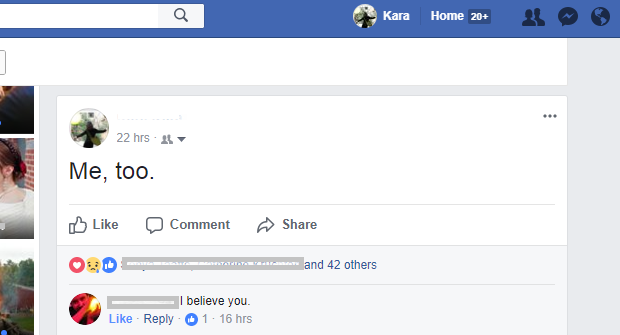
But here’s the good news: Yesterday’s movement was an excellent first step, as was the #IBelieveYou hashtag that people were posting in response. As the sheer volume suggests, sexual harassment and assault are appallingly common — across generations, across socio-economic status, across orientations, and across the gender spectrum. Silence is a necessary component of system navigation for sexual predation; a problem that isn’t identified cannot be fixed. It’s just that silence is not the only component.
So what are we doing from here? Now is a great time to turn social momentum into social action. But that’s easier said than done, especially when it’s so unclear what people can be doing to help! So here are some modest, concrete suggestions on how to do that:
Learn How to Become an Active Bystander. This one is on all of us, but it’s especially anyone who is placed in the role of a bystander to violence — people who are observing a casual interaction take place, especially in less high-stakes social contexts. (A friend of mine observed that he wasn’t sure how to handle violence in inherently power-stratified environments like the workplace, which is a very fair observation, and I’ll get to that below.) The potentially helpful role of bystanders, especially in instances of sexual violence, is verywell–documented — and so is its corollary the bystander effect, which by definition helps perpetrators maintain a status quo. The National Sexual Violence Resource Centermaintains a resource list and information packet for learning how to be an active bystander, as does Partners to Social Change and RAINN. Take some time to read up on what concrete actions are helpful to others in dangerous situations!
Learn How to Talk to Survivors. Statistically speaking, you probably know somebody who is a survivor. It’s a good idea to learn emotional first-aid generally in our current political landscape, but at minimum, it’s a great idea to take a few minutes to reviewresourcesuggestions on how to navigate assault situations specifically so that you know how to handle it when someone discloses this history to you. (The good news is, if you said “I believe you” yesterday, you are already doing a very important piece of this!)
Learn to Spot Attempts to Enlist Assistance to Violence. A systemic structure of sexual violence (or any structure of violence, honestly) relies on complicit assistance from everyday people. Those people are not monsters; they’re just people who aren’t aware what’s up and can be enlisted as tacit support as a result. And sometimes it’s not possible to speak up without taking on substantial risk, especially in our current environment, but you should always be making that conscious choice instead of just not noticing when your silence is taken as support. Take yourself out of the pool of people who are accidentally helping whenever you can — learn to recognize instances where your supportis beingenlisted indirectly through social interaction. This can be in big ways, but it can be in little ways, too — the stereotypical “women, amirite?” phrase exists for a reason; it’s building consensus and reinforcing the beliefs held by the speaker. No, that person is not right, and it’s okay to tell them so!
Go Forth and Do the Things You Learned in the Wild! Listening is an important first step, and learning is an important second step, but ultimately these things are building towards action. Now is the time to put the things you learned into practice when it’s practicable to do so — which is uncomfortable and it sucks, but not as much as people getting assaulted. Several of the resources listed above have concrete suggestions and steps for how to handle specific situations. It’s really, really valuable and important to spend some time figuring out how to integrate them.
Call Your Reps, Call Your Reps, Call Your Reps, Reps, Reps. A lot of the systemic changes happening right now are on a giant scale, and that’s big and scary and awful. But it also means that you can help by simply exercising your civic rights as a citizen on issues of policy. Stay attuned to issues like coverage changes to the ACA and the abortion bill in the House, and call when you can. If you can’t call, use resistbot to text faxes. If you can’t do either, stay informed. These things might feel like they aren’t related but they really, really are.
I have about a billion other thoughts on this topic, and I might ultimately say more, but for now, I think I’ve hit the major highlights. Thank you for paying attention and join the conversation, and please stay in the fight! We need to all participate if we’re going to build a better culture.
This week started out really rough and ended up really strange — we had a lot of very traumatic and troubling events in the earlier half of the week, but by the end of the weekend Trump was taking credit for inventing the word “fake.” It’s sort of like being stuck in a horror movie where the killer stabs someone on Monday and then comes back on Friday to ask the survivors “What’s the deal with soap?” (Also, I know the news cycle has practically become minute-by-minute these days, but this is ridiculous.)
Standard standing reminders apply: I am no journalist, though I play one in your inbox or browser, so I’m only summarizing the news within my area of expertise. This week’s news contains a lot of detailed analysis that’s outside my expertise — I’m a lawyer, not a football player! — but all offroad adventures are marked with an asterisk. Okay, I think that’s about it for the disclaimers. Onward to the news!
Constitutional Crisis Corners:
The Russia Collusion Investigation saw a lot of movement this week:
But Her Emails (Take 2).* More information came to light on last week’s White House Aide Private Server story, and none of it is great. There was apparently a third email address on a private server that both Jared and Ivanka used (and failed to report using) while working as aides. This is understandably not thrilling Democrats — House rep Elijah Cummings is asking for a formal FBI review, and fellow reps Ted Lieu and Don Beyer wrote to White House counsel Don McGahn to request their clearance be revoked. Then, just for extra cake icing, the story broke that Ivanka Trump narrowly avoided a criminal indictment in 2012 when a Trump attorney convinced the New York District Attorney to drop the case. So that all happened.
We also are still in a stalemate on the Threat toFree Speech front:
Trump Still Hates Sports. The bizarre battle between our President and the NFL continues for yet another week, with Mike Pence walking out of a game he conveniently decided to attend because players on the other team protested during the anthem (or, more accurately, because Trump told him to). By the way, as Slate notes, the political stunt cost taxpayers over $200,000, and that kind of publicly-funded race-baiting by a Presidential administration is completely unprecedented as well as a gross misuse of taxpayer funds. Basically, it’s an intentional and ongoing Presidential move to chill free expression that I’m tired of talking about even though it remains incredibly important that we pay attention to it.
The Trump Show Continues. The Trump Administration Reality Show was particularly strange this week, especially towards the end of the week. The brightest gem in the collection was definitely Trump claiming he made up the word ‘fake,’ which I can’t even begin to guess about (though you have to admit, he does kind of redefine the term). But that bizarre behavior had lots of friends — there was also Trump’s absurd decision to pick a fight with Republican Senator Bob Corker, which is going to hurt him in at leastthreedifferent ways politically (in addition to Corker’s incredible tea-sipping commentary and impromptu tell-all interview). And just to cap out an already deeply weird week, there’s now a three-way fight happening about who is the true First Lady of this administration, leaving Andy Cohen — the producer of ‘Real Housewives’ fame — to tweet that “Even I AM SPEECHLESS.”
Rex Tillerson Holds a Press Conference About Saying What We’re All Thinking. After news broke that Rex Tillerson called Trump a ‘moron’ at a Pentagon meeting and considered resigning over the summer, Tillerson and Friends ended up holding a press conference — and merely addressed the idea that he was about to resign, leaving whether he actually disparaged Trump’s intelligence as an exercise for the reader. Though some of the press were speculating that he might be another Friday Firing faux-resignation, Tillerson appears content to stay in his post until Trump literally fires him.
Tim Murphy Scandal Unfolds Like It’s 1998. Pennsylvania rep and All Around Slimeball Tim Murphy landed in hot water this week, when news broke that he was pressuring his mistress to have an abortion after she became pregnant with his child. Though he initially claimed he would simply not seek re-election, eventually he folded to mounting pressure and agreed to resign more promptly. Between someone actually being forced to resign over immoral choices and the whole thing taking weeks (rather than hours) to unfold, it was a very nostalgic sort of scandal!
The Bad:
Trump Went to Puerto Rico and it was the Actual Worst. Trump did end up taking a trip to Puerto Rico on Tuesday, which ended up being an odyssey of blatant mischaracterizations, surreal t-shirt-cannon style paper-towel launching, and countlessoffensiveandtactless comments — but not very much actual help. After it was over, FEMA removed statistics about how much of the region has power and water (which, according to an official Puerto Rican website, is about 15% power and 55% water respectively, in case anyone was curious). Meanwhile, it’s unclear whether Congress will provide more aid to the island, which is still sorely needed post-visit. Though government responses have been sluggish, several nonprofit entities have been working tirelessly; I’ll write more about that below.
Trans Rights Should be Civil Rights. Sessions reversed course on another Obama-era protection this week, this time on a directive clarifying that gender expression is covered under Title VII of the Civil Rights Act. The directive gave protection against workplace discrimination for transgender Americans, which has effectively been removed; it’s realistic for trans Americans to expect that workplace discrimination based on their gender expression has effectively become legal again. The Sessions memo made it clear that this would be the Department position on all legal issues related to sex moving forward. Ordinarily I would put a pithy statement here, but I’m still really mad about it, so I’ll content myself with saying that it is not ideal.
Trump’s Alarming Non-Diplomacy with North Korea.* Trump continued his disturbing gambit with North Korea this week, saying that Tillerson was “wasting his time” on diplomacy. Meanwhile, Russia is apparently claiming North Korea has missiles that can reach the west coast of the US, and Trump referred to this week as “the calm before the storm” but wouldn’t say more about what that meant (though it was probably in reference to either North Korea or abandoning the Iran nuclear deal, which he’s expected to do next week). Though Ted Lieu opined publicly (and probably accurately) this week that Trump has “no strategy on North Korea,” Trump did tell military leaders this week that “our goal is denuclearization.” Hopefully he doesn’t intend to achieve that by goading Kim Jong-un into chucking his entire arsenal at us.
Continuing UN Embarrassment. The United States joined twelve other UN countries this week in refusing to condemn the death penalty for certain kinds of conduct — namely, apostasy, blasphemy, adultery and consensual same-sex relations — when the penalty is applied in a discriminatory manner. The resolution passed anyway, by a sound majority of 27 to 12. What we did support was a failed amendment by Russia asserting that the death penalty was “not necessarily a human rights violation.” ‘Murrica.
What Is Even Happening in the EPA.* News broke this week (well, for some definitions of ‘broke’) that Pruitt does many things that hurt the credibility and functionality of the EPA, such as spending lots of time with industry executives and spending agency funds on questionable things such as frequent travel to his home state and a $25,000 phone booth (yes, really). But Trump managed to one-up himself with his pick for deputy director, who is a literal coal lobbyist. As in, “he was registered as a lobbyist two months ago.” What’s particularly noteworthy about this pick is that Bannon is no longer advising Trump and yet his nominations look identical to when he was — either Bannon actually does still have Trump’s ear, or Trump hates the EPA so much that he doesn’t need to have any kind of deconstructionist agenda to actively try to destroy it.
The Good:
NRA-Approved Gun Control Reform.* In the wake of the Vegas tragedy, Senator Feinstein introduced a bill this week that would ban bump stocks, which are a form of gun modification that allows a semi-automatic weapon to function as a rapid-fire automatic firearm. A similar bill is anticipated in the House this week as well. Though this is far from a complete guarantee of public safety, it has the rare distinction of being a restriction favored by the NRA — my cynical guess is that the association has its own reasons for not favoring weapon modifications, but at the moment I’m just grateful that the restriction is likely to go forward.
And that’s what I have, in all its terrible and deeply strange glory. Daily news summaries like WTFJHT remain a very good idea for the foreseeable future. Here’s hoping that next week brings better tidings!
Still life — a boot on a newspaper, by Ernest Blaikley [Public domain], via Wikimedia Commons
The news is a horrible, toxic trash fire this past week, and I don’t think I’m even capable of sugar coating that. Puerto Rico’s in a bad way, over 500 people were seriously injured (and 59 were killed) by one dude with way more automatic weapons than any one dude should ever have, and Trump still hasn’t been to the Caribbean but he somehow found time to go to the golf course. I recently posted an article about how to deal with weeks like this, and that’s about the best I got for you right now; I’m really sorry, folks. No judgment if your comfort food this week is an entire bag of Cheetos.
Standard standing reminders apply: I am no journalist, though I play one in your inbox or browser, so I’m only summarizing the news within my area of expertise. This week’s news contains some detailed analysis that’s outside my expertise — I’m a lawyer, not an accountant! — but all offroad adventures are marked with an asterisk. Okay, I think that’s about it for the disclaimers. Onward to the news!
Constitutional Crisis Corners:
The Russia Collusion Investigation was mostly pretty quiet this week, but we did have a little bit of movement:
But Her Emails. The big story of idiocy this week was the news that at least six White House advisers used private servers for sending and receiving emails in their official White House capacity. Some of the advisers, such as Steve Bannon and Reince Priebus, are already gone — but several, such as Jared Kushner, Ivanka Trump, Gary Cohn, and Steven Miller, are still present. Kushner in particular is estimated to have sent and received about a hundred emails between January and August, which is kind of horrifying when you consider that he went on several diplomatic trips in that time. The White House, as you can imagine, was just shocked to discover that — nope, sorry, that’s what would happen if we weren’t living in the darkest timeline. As it happens, the same administration that crucified Hillary Clinton over this hasn’t issued statements or censures of any kind to its own people — the best we’ve gotten on this so far is an internal probe being led by White House counsel’s office — and if you’re currently sitting here asking “But isn’t Don McGahn, current White House counsel, rumored to be about to quit over Jared Kushner?” Why yes, yes he is.
We also are still in a stalemate on the Threat toFree Speech front:
…and the Rotted Pork Likely to Be Snuck In. Remember how I mentioned that the GOP is hoping to do all this under the reconciliation process, which is the same process they used to try to pass ACA reform? Guess what else that means! (If you guessed “they’re going to try to do ACA repeal under the tax reform process,” you win! And by ‘win,’ I mean ‘congratulations, here’s several more months of healthcare-based night terrors!’) It looks like Graham’s obnoxious plan to kick the can down the road isn’t generally popular within the GOP, but that could change at any time — especially if the GOP pushto remove the filibuster entirely gains traction instead.
The Price was Wrong. After much brouhahaabout Tom Price’suse ofcharter flights on the government dime (which Rachel Maddow correctly notes would ordinarily result in a disgraced resignation), Health and Human Services Secretary Tom Price did indeed resign last Friday. My researcher correctly called this ahead of time, noting that we haven’t had a Friday firing in a while, but I had trouble making Price’s resignation jive with my understanding of the Trump administration’s blatant laissez-faire attitude about self-enrichment at government expense. Then, when I was compiling my notes this past week, I remembered that DHHS had been criticized by the administration at the beginning of last week for a leaked draft of an “ideological” report concluding that refugees help economies more than they hurt them — and suddenly it all made sense again.
Immigration Inconsolate. The administration took a number of follow-up swings at immigrants this week, in addition to the horrifying treatment of U.S. citizens in PR detailed above. First news broke that the administration wants to set this year’s refugee capat 45,000 people total, which is 65,000 lower than President Obama set the cap before leaving office in 2016, and literally the lowest cap ever set since we started the practice in 1980. Then for an encore, the administration finalized plans to collect social media info of permanent and naturalized immigrants, which both infringes on the rights of U.S. citizens and also is just a disgusting and nebulous invasion of privacy, since it will mainly be used on people who already lawfully reside in the United States. And after that, the administration wrapped up a four-day retaliatory ICE raid on places they deemed sanctuary jurisdictions called “Project Safe City,” which resulted in 500 arrests from ten locations. (My state of Massachusetts, perversely, was targeted because of a recent Mass Supreme Judicial Court decision.) A little under half of those arrested had no criminal history at all, despite the name of the operation.
The CHIPs Are Down. The LA Times reported on Sunday that Congress had failed to renew the Children’s Health Insurance Program — a program that provides coverage for nearly nine million children annually — before breaking for the weekend. It will be another week or more the error can be rectified. The worst part? It apparently wasn’t even on purpose, because the Senate Finance Committee had already had a deal on the table for five years of funding. The Senate was just distracted by the Graham-Cassidy circus and failed to enact CHIP funding in the three full days they had after they decided not to vote on Graham-Cassidy. I can’t even with this Congress, y’all.
Mass Shooting in Las Vegas. A country music concert on the Strip in Las Vegas turned deeply horrific yesterday, when a gunman with 23 firearms in his thirty-second-story hotel room indiscriminately rapid-fired at thousands of people. Over five hundred people were injured, and fifty-nine people were killed. The shooter was identified posthumously as Steven Paddock, a 66-year-old white man from Mesquite, Nevada. He had no criminal record and no documented mental health issues. He also had no documented ties to any terrorist organizations (ISIS initially claimed credit for his attack, but ISIS would claim credit for Hurricane Maria if they knew who to call about it, so they’re not exactly credible). The attack left the nation reeling and re-opened conversations about gun control just as Congress was due to consider a bill rolling back silencer provisions, which likely will be tabled in the wake of the tragedy. Trump has said he plans to visit Las Vegas on Wednesday.
Just like last week, the news required multiple drafts this week — the news cycle is still pedals-to-the-metal at the moment. Daily news summaries like WTFJHT remain a very good idea for the foreseeable future. Here’s hoping that next week brings better tidings!
Let’s face it: As we’re navigating The Trashfire National Policy of 2017, we’re all getting traumatized — it’s tough to get used to that dull-roar screaming we all hear every time our illustrious President vents his spleen on Twitter. And many of us have other stressors in our lives that are making it even harder to navigate, because life does go on even in the face of an abusive relationship with our government — and life is hard. And all that is before we consider the very real practical realities of living without necessities like food or water, or living without healthcare, or living in fear of physical attacks. In the wake of this weekend of introspection, I’ve had many conversations with folks about how to live instead of just surviving, and in some cases simply about how to survive.
So I’m taking off my lawyer hat for a moment, and putting on my trained clinician hat, to talk to y’all about how to deal with trauma. And to begin this conversation, we need to start with a simple truth commonly understood by first-responders everywhere, and borne out by research: Trauma is aformofinfectioustoxin. You have to clear it out in order to get healthy, and staying healthy will help you resist it further, both in your own life and when loved ones’ trauma threatenstoinfectyou. And that’s not to say that we should stop exposing ourselves to toxins, which often isn’t possible and in many cases would be morally reprehensible. Rather, I’m saying the opposite: Becausewe’re all in this toxic soup together, that means we gotta help each other, and to keep doing that we also gotta help ourselves.
So I’m submitting for your perusal a kind of Trauma Resilience Roadmap — concrete suggestions and links to research, separated into three buckets: Do This Immediately, Do This When You Feel Able, and This Will Take Startup Cost But Will Help I Promise. I can’t promise it will fix everything, but it’s my hope that for many people (including myself), it will be a start.
Do This Immediately (or: Emergency Recentering Treatments)
These are the things you need to do when you’re at the stage where you’re asking, “But how do I survive?” Acute crisis mode has its own set of rules, and that can be hard to accept but it’s important to acknowledge. The flip side is that acute crisis doesn’t last forever, and this list will hopefully help you come out the other side.
Stay well-hydrated. It’s such a little thing, but trauma and stress create both physiological effects that can be exacerbated by dehydration (e.g. muscle tensions, headaches) and also creates a bunch of chemical junk in your system that can be flushed out by drinking water really often. Studiesshow drinking enough water really does help, and very quickly.
Give yourself permission to tune (non-essential) things out. Whatever secondary things are stressing you out, and I’m guessing this is a large list, it’s okay and even a very good idea to put it down for a moment or two when you’re in crisis. Twitter will survive a Monday without you. That friend who needs an ear about her mortgage payment can find another one this Tuesday. Obviously, this only works on the stressors that aren’t center-stage right now. But I honestly, truly mean this: It’s okay to be ruthless about random stressors when you’re in crisis.
Start a list of images and activities that always soothe you. This might be hard if you’re in the middle of a huge amount of stress, but even something as simple as “I feel better when I look at otter pics” and then looking at some otter pics can buy you a tiny bit of cope (which I’ll colloquially refer to here as “cope points”), and that can be pointed towards a larger and more permanent form of help down the road. Don’t aim for an exhaustive list right now; just list the stuff that you immediately think of as bringing you joy and comfort, with a bias towards things you feel able and ready to do right this moment. And if you know things that you don’t feel able to do right now but always help (e.g. going hiking, mindfulness exercises, book-binding), go ahead and put them on the list. But don’t try to do them right now; they’ll still be there when we get to Phase 2.
Accept (even trashy) activities that help you tread water. For me, this happens to be inane phone games — they take up my whole screen and block out social media, which means I’m definitely tuning things out as I play (and also, match-3 games are really satisfying for me; I have no idea why). It might be eating junk food for you, or watching really crap television, or reading truly awful fiction novels — things that if you were doing well might make you think “I’m judging myself for doing this right now,” but aren’t actively destructive or harmful. This can also be low-cost things that you’re less likely to be self-judgy about (e.g. watching really good television, eating delicious salads, reading excellent literature) but hopefully you started doing those already with Item #3. If you aren’t, you should let yourself do those things in your spare moments. If you are also doing Item #2, you have more spare moments to do them. 🙂
Here’s a sample beginner list:
1) Watch my favorite movie;
2) Read some really awful fanfic;
3) Look at cat GIFs on the Internet;
4) Cookiepalooza;
5) Play Rock Band
Do This When You Feel Able (or: Convalescent Recentering Activities)
These are the things you need when you’re at the stage where you’re asking, “How do I live instead of just surviving?” It’s my guess that after nine months of President Cool Ranch Mussolini, most of us are who aren’t in immediate crisis are hanging out at this stage. It’s the trauma equivalent of being stuck in bed with a stomach bug yelling “but I wanna eat tacos!” — we’re all well enough to miss things, but not well enough to have them yet. This part of the primer is the transition from “I can’t get out of bed” to achieving your taco-nomming dreams.
Stay well-fed. This one can be hard for people in the middle of crisis, for about a million reasons. But once you’re feeling okay enough to pay attention to it without feeling like OH MY GOD A MILLION THINGS I CANNOT EVEN, good food hygiene is an incredibly valuable foundation for mental health; there are lotsandlotsofstudiesthat show that people who are experiencing trauma are less able to adhere to good food hygiene and also suffer more when they can’t. If you’re a person who has trouble eating when stressed, “good food hygiene” can look like “I ate some Cheetos at midnight before I fell asleep in an orange-coated haze” as long as other, more nutritious calories happened also — it doesn’t literally mean “only eat things that are good for you;” it means “put calories in your system on a regular basis so that a blood sugar crash doesn’t happen on top of everything else.” (Long-term daily Cheeto binges might lead to other problems, obviously, but we’re talking short-to-medium-term here.) Some people do have the opposite reaction to stress, and stress-eat everything in sight; for those people, good food hygiene might look more like “pause and evaluate whether I feel hungry before I put this thirty-first food item in my face.” (Note that we’re discussing common immediate stress reactions to food rather than systemic eating disorders, which obviously have their own set of rules and treatments.)
Get enough sleep. This is basically the same as the notes above — goodsleephygiene is a tremendously helpful foundation for mood. But this one is super hard to do if you’re not doing well; I personally find it about a million times harder than shoving food in my face when I’m too stressed to be hungry. For me, optimizing sleep hygiene looks like skipping that third cup of coffee (unless I really need it), taking a melatonin pill before bed, and hoping I don’t have nightmares. Your mileage may vary. But in general, the more other forms of decompression help, the more sleep stops being an elusive beast and becomes a regular part of life again. And that’s a really important step for resilience.
Ride the Hygiene Horse generally. There is absolutely zero shame in forgetting to brush your hair, skipping a shower, or otherwise forgetting a regular daily hygiene thing when you’re in immediate crisis — in fact, it’s a common symptom that something is very wrong. But once you’re out of crisis mode, it’s super easy to start being angry with yourself for forgetting things — or doing the opposite, and feeling like you just don’t have the energy for tasks like showering. (Or both. Some lucky people experience both.) But once you’re in “I feel ready to eat and sleep normally” mode, it’s a good time to make sure you’re keeping ordinary hygiene habits all around. They help, and they matter, and not doing them long-term can affect mood and keep you in a dark place.
Make a more complete, long-term list of recentering and joyful things. Once you feel able, make a comprehensive list of all the things that bring you joy and help you feel More Able to Even after you do them. Hopefully, most of the things that are really easy (e.g. “Look at doggo pics,” “Reread my favorite novel,” “Eat Cheez-Its”) are already on your list, but this is a good time to add the less low-hanging fruit — things that you know help but didn’t feel approachable in the middle of crisis. It’s also a good time to spend an hour or two really thinking about what brings you joy and comfort — and if you feel able, take your best guess at what is an easy thing, what is a medium thing, and what feels like a hard thing right now. You may or may not feel ready to do all these things (and my guess is some of them will feel super far away), but making a list of them helps you prep and move forward for when you do feel ready. And some of them might feel within reach, which can give you back extra cope!
Try simple meditative activities (that aren’t literal meditation). A friend of mine mentioned meditative coloring today, which honestly is a really good low-cost meditative activity. Some people find cleaning to be stress-reducing when they’re at this stage. If you’re like me and find repeatedly stabbing things really satisfying when stressed, embroidery is pretty great. The goal is to aim for things that give you a quick cope point in the moment, don’t eat more than maybe one cope point to set up, and then give you an extra cope point when you can look at them later and think “Look what a productive thing I did!” But at this stage, easy activities that you know how to do and feel comfortable doing mindlessly are best. Bonus points if they’re also on your list. (Also, this is a great way to slowly expand your list! 🙂
Here’s a sample second-stage list:
1) Easy activities — I’ve been doing these all along:
Watch my favorite movie; Reread my favorite book; Look at cat GIFs on the Internet; Eat Cheez-Its; Play Caves of Qud
2) Medium Activities — try some of these if I can:
Embroidery projects; Meditative coloring; Clean my workspace; Read nonfiction; Cook more meals
3) Hard Activities — I’m not ready for these yet:
Learning book-binding; Going on regular hikes; Working on my novel; Going to the gym regularly
This Will Take Startup Cost But Will Help, I Promise (or: Long-Term/Preventative Recentering Activities)
These are the things that you want to keep in your life as you navigate low-grade ambient stressors (such as hearing 45’s voice on the television as he discussed tax reform) — it’s for when you’re feeling well enough that you should no longer be tuning out the white noise that accompanies an inherently traumatizing atmosphere. We owe it to ourselves, and to each other, to do what we can to stay engaged but healthy as we all walk through this nightmarescape. Here are my modest suggestions for how to do that when you’re not in crisis.
Get out of the house on your own terms. Meet a friend at a bookstore; go for a walk; get some coffee from that awesome cafe you haven’t been to in a while. Something that requires physical movement, brings you joy, and feels like the opposite of retreating or withdrawing. It’s super-important, by the way, that this be a thing that you are doing for yourself and on your terms, rather than because someone dragged you or guilted you into it. It’s not going to be useful for decompression if you’re being dragged (and you’re not the one doing the dragging).
Try some of the stuff marked ‘hard’ on your recentering list. Try your hand (see what I did there?) at watercolor, or some other task that you know brings you joy but has felt far away lately. Don’t be angry with yourself if it doesn’t quite click; these are things that take cope to give cope, and it just means you didn’t have the cope for them yet. Go back to some of the easier tasks and do those — you’re still healing, is all. But if the thing brings you joy and feels net-positive, it’s a really helpful marker for knowing where you are in this process. Plus you got to do a thing that brings you joy! (Note: Now is also the time to purge the list items that you felt kind of mixed about or would be harmful to rely on too long in the long-term.)
Try more complex meditation. Some people find going to the gym really meditative. Some people get a lot out of traditional mindfulness meditation, such as guided meditation or progressive muscle relaxation exercises or something similar. I’m partial to singing-based meditation. But basically, this is the time to try varying simple tasks that are meditative through repetition (e.g. coloring, sewing) with activities that are meditative in a more traditional sense. There are lots and lots of studies that show that meditation can be extremely helpful to people for stress resilience, but trying to do it when you’re still actively processing toxic trauma is really hard.
Consider setting up a therapy appointment. There is seriously zero shame in setting up an appointment if you think about it carefully and decide you need one. There’s also zero shame in deciding it’s not right for you. Basically, just a good thing to evaluate at some point — people see an eye/nose/throat doctor if they’ve had a sore throat for forever; people should also see a therapist if something has been wrong with their stress or trauma levels forever.
Evaluate what stressors you are managing. Some stressors (e.g. natural disaster, getting sick, jerks on public transit) are not avoidable, and will always require navigation and detoxification. Some (e.g. a romantic partner wanting to spend time with you) are stressors when you aren’t doing well, but are either positives or neutral things when you are doing better. And some (e.g. that one friend who wants you to loan them $20 literally every day) are literally always stressors and never necessary to navigate. Figuring out long-term planning for stressors, and how to set boundaries for the random white noise you just super don’t need, takes energy but also is generally a really good step for health. Approaching stressors with intentionality can both help you gate-keep and also give you a sense of control over your situation.
Keep doing all the things on the convalescing list. We don’t stop needing the things that bring us joy when we’re no longer in crisis; in fact, ability to do the things that bring us joy is arguably what it means to be living rather than surviving in the first place. And things like good food/sleep/personal hygiene and staying hydrated stop being optional when we’re constantly taking in stress.
View your stressor intake and decompression as an equation that needs to be balanced. You can take in more stressors when you have more in place to center you. You can take in fewer stressors when something major is going on — be it crisis, chronic limitations, or something else. At the end of each day, this equation needs to balance, or burnout, depression, and disengagement can occur. And that’s an outcome nobody wants, or even should want.
The reality is that most of us will yo-yo between these three stages as new horrors crop up and create new crises — it’s like a morbid game of Chutes and Ladders that we play with our mental health instead of meeples. And when something serious happens, and you have to go back to the beginning of the roadmap, that’s okay — being able to identify and acknowledge current stage of crisis, and current level of trauma, won’t fix everything. But it’s an important set of tools that we can use to support ourselves and each other. We can get through this, and we will. It’s my hope that this roadmap will help.
It’s cold season Chez Roundup, and only my live-in editor escaped the plague. (You may note, by process of elimination, that this means your favorite news compiler did not.) I mention this because I feel a great temptation to conclude that this past week was a terrible fever dream — it’s been a strange, dark week. Sadly, no matter how much I nap, the news doesn’t seem to improve.
Standard standing reminders apply: I am no journalist, though I play one in your inbox or browser, so I’m only summarizing the news within my area of expertise. This week’s news contains some detailed analysis that’s outside my expertise — I’m a lawyer, not a tech guru — but all offroad adventures are marked with an asterisk. Okay, I think that’s about it for the disclaimers. Onward to the news!
Constitutional Crisis Corners:
As we’ve come to expect, there were some developments in The Russia Collusion Investigation this week:
Facebook Now Cooperating with Congress.* It took them months, but they got there eventually: Facebook is now cooperating with congressional investigations into the ads they sold to Russian troll farms. (Facebook had already shared some information with Mueller, though this development was fairly recent as well.) Incredibly, Facebook had been claiming that it violated user privacy to share what ads had been stuck on their feeds without their consent — because we all know that Facebook is extremely good at figuring out what we want to see on our walls. (Though it is absolutely true that the company treats users like data mines, but that’s kind of besides the point on multiple levels here.) At any rate, it’s good that they are cooperating now.
Refugee Revisionist History. I suppose I should be used to this by now, but the White House straight-up rejected a report from the Department of Health and Human Services this week. The flaw in the report, as it turns out, was not in its methodology or data; it was reporting that refugees brought in $63 billion more revenue than they cost. In other words, our government actively rejected a report because it said a thing they didn’t like, after they asked for the report because they hoped it would say the other thing. Also, the White House apparently thinks Secretary of Health and Human Services Tom Price runs a Department “politically motivated” to say nice things about refugees. Yes, we’re talking about the same Tom “I cosponsored a bill to refuse refugee resettlement” Price. I seriously got nothin’.
Travel Ban v 3.0. On Sunday, the White House issued a proclamation about a new travel ban, presumably because the temporary ban was about to expire. And the results are both confusing and horrible. There are now seven countries that are banned indefinitely from long-term immigration and many forms of short-term visiting of the United States, starting on October 18. (Venezuela’s government officials are barred as well, though it looks like many forms of travel remain in place for the country generally.) Penn State Law School put out a good summary of what the ban actually entails, though even they appear a bit uncertain of some of the finer points (such as what it means that refugees both are and aren’t banned under the wording of the proclamation). Just to make things even more confusing, oral arguments before the Supreme Court were canceled in light of this development, though the case is still pending before the Supreme Court and the parties are preparing new briefs. So stay tuned for more bizarre and probably illegal updates as they occur.
Uncle Donny’s Firearms Emporium.* Trump is in the process of moving international gun sale oversight from the Department of State, which historically has governed said sales, to the Department of Commerce. The main effect of this in practical terms is that it will make it easier to sell firearms overseas. Though gun sales had been down in the recent past, it’s unclear why raising them was a particular goal of Trump’s. But I’m gonna go out on a limb here and guess the answer is not “world peace.”
Maverick Maine and McCain (Maybe). John McCain announced this week that he won’t vote for the Graham-Cassidy bill, which is a bit confusing because when the bill first came on people’s radars he was one of the first to say he would. But his announcement was followed by Susan Collins announcing the same thing once she had reviewed the CBO report. So assuming McCain is accurately reporting, his decision puts the bill in serious jeopardy (as well as pissing off the President, which is always a nice bonus). If as few as three Republican senators vote ‘no’ on the initiative, it definitely won’t become law, and there are a lot of potential third ‘nos’ in the current landscape. (Though new versions of the bill court Lisa Murkowski, she hasn’t yet issued a final statement either way, and Rand Paul has been vocal in his opposition as well.) This is far from a done deal, and we need to keep calling our Senators! But the Graham-Cassidy bill may very well go the same route as the July bills.
Paris Accord Gains a Participant. (Just not us.) President Ortega announced that Nicaragua will join the Paris Accord this past week, leaving only two final holdouts from the world agreement — Syria and us. In statements on the topic, Ortega cited recent climate change natural disasters as his reasoning, saying, ““We have to be in solidarity with this large number of countries that are the first victims, who are already the victims and are the ones who will continue to suffer the impact of these disasters.” Nicaragua’s support makes the accord stronger, and might serve as an impetus for private entities in the United States to continue efforts to support the accord.
This week’s news changed so much that I had to draft it three times since yesterday — if anything, the news cycle is getting faster, which I frankly did not think was possible. Daily news summaries like WTFJHT remain a very good idea for the foreseeable future. Until next week, good night and good luck!