Image taken from Piano Sonata No. 13 in E♭ major, Op. 27 No. 1, “Quasi una fantasia”, available in the public domain
I have been a performer the vast majority of my life. Some of my earliest memories involve song or dance; I picked up my first instrument the second my school gave me the opportunity. By high school, I was in so many different fine arts groups that I didn’t bother with a lunch period – I just scarfed my food during the first ten minutes of choir. I did manage to calm the theater kid energy at least a little by the time I hit college, but I still sang, directed, acted, arranged. Even during law and grad school, the most chaotic and academically rigorous time of my life, I performed. It was part of me. It was who I was.
Yet as I moved deeper and deeper into activism in response to the 2016 election, my creative life grew sparser and sparser. After a staged reading and a children’s concert in January 2017, I stopped performing in public. Eventually, after my last collaborative album was released in January 2020, I stopped performing entirely. I was an advocate; awriter; afighter. Creative art of all kinds became a thing I did for myself, in spare moments as I found them, and not a thing I shared with my communities. I told myself that for me, creative art was a form of self-care, akin to meditating or exercise. I told myself it was enough.
‘Sharpened Pencil Next to Sheet Paper’, created by the Thomaseagle, available by Creative Commons Attribution 3.0 Unported license
We talk a lot, these days, about the importance of joy in activism. We talk about the importance of community a lot as well–the need for solidarity in liberation; the value of mutual aid. I have even seen performances support mutual aid to great effect, through efforts like Theatre@First’s annual Giving@First festival. But somehow, I didn’t see a way to fit in performance arts alongside my own work. I didn’t know how to juggle creativity I loved with advocacy my communities needed.
Truthfully, I still don’t, but in the past year I have begun performing again anyway. I sang Hearthfire at a Bardic circle this summer; I sang the same song and several others at my first concert in nine years earlier today. Both times, I thought: I love this. I thought: This makes me feel human and connected.
Ultimately, what is performance? Performance creates a platform and it organically creates messaging, but it is more than that; it’s a way for people to share connection. An audience watches because something happening before them resonates; the audience and the performer form a temporary interpersonal relationship. Fandom, in turn, can create a longer-term community. But perhaps more uniquely, there is shared joy in creative performance. There is social power in creative performance. Show me a person who connects with an audience, and I will show you a person who creates agency of expression in a socially meaningful way. And frankly, they probably love what they are doing as they do it.
Unnamed image by Omtay and released to public domain
When we say community and joy are necessary to movements–creative art and performance should be part of that, even for those of us who do this work full-time. (Perhaps especially for those of us who do this work full-time.) I shouldn’t be juggling social change and performance in the first place, because they are already linked. They enhance each other.
Instead, the questions to be asking are how to bring out social change themes in performance, and how to bring performance overtly into advocacy. Many of my colleagues–especially Black colleagues–already excel at this. To give recent examples, the AATCLC has been hosting spoken word poetry sessions about tobacco use since 2023; Brass Solidarity has been bringing marching bands to community action events since the George Floyd protests in 2021. But this tradition goes back more than fifty years, and Larry Neal famously described the Black Arts Movement as the “aesthetic and spiritual sister of Black Power” in 1968. Pairing art and activism, these efforts build something sustainable and important.
Image created by KeithTyler; clenched fist motif itself is in the public domain
It’s not healthy activism to deny a part of oneself; that much I already knew. (I hope you, Dear Reader, already know it too.) But the idea I internalized today is that it does my work a disservice to even try. I still feel daunted by next steps, but I also feel energized. This is a form of community and joy that I can understand–that I believe many of us can understand. And I look forward to bringing these things to my work more in the coming year.
(This is the googolplexth installment of a series of articles unpacking the many horrifying immigration implications created by the Trump administration. Though I am not an immigration specialist, I am a legal generalist working with indigent populations professionally full-time. This article is not intended to form an attorney-client relationship or constitute legal advice, though it is my hope that it will help people feel equipped to take action.)
As all of us living in America watch the immigration enforcement machine churn, it can be hard to know how to best help — if you’re not an immigration lawyer and not personally involved, direct action can feel elusive. But there are definitely things that help slow this hydra down, and most of us can take many of these actions in our day-to-day!
Before we start, some disclaimers: This primer is intended for folks who want to help non-professionally and are not themselves a primary target for detention or deportation— it assumes no cultural or professional ties to immigrant populations, which impacts the nature of the suggestions. Some suggestions may be difficult for government workers, but I tried to include a broad range so that even folks who can’t lobby or donate have things they can do. Okay, onward to the suggestions!
1. Know and Support the Major Players
Immigration law is quite a rabbit hole, and sub-specialization is very common — folks who do asylum work full-time may look at changes to public charge and think, “Whoa, that’s not my burrow.” But for each common issue, some credible orgs will come up over and over again. It’s a good idea to get to know these organization names, because this first step will make every other suggestion easier to do long-term.
Learn Your Local Policy Actors. Though immigration is a national issue, many states have more localized coalition or coordinated grassroots efforts. It’s worth learning who does this in your area! Many places have groups that will come up if you Google terms like “immigration,” “network,” and/or “coalition” with a state name. And if all else fails, the Immigration Advocates Network has a database of state legal resources that includes many local actors. (That said, if you live here in Massachusetts, I can just tell you to check out the Mass Immigrant and Refugee Advocacy coalition; they do great work.)
Where to Go to Learn More. When in doubt, Google is your friend here, but many entities take pains to make this information easy to find. Some groups in particular (e.g. National Immigrant Law Center, Informed Immigrant, #StandWithImmigrants) issue a lot of updates and news bulletins to keep people informed. That makes them a great place to start if you’re looking to learn what’s going on! As I’ll talk about below, credible information sources are really, really valuable — and likely to remain so as we move forward.
2. Talk to Your Government
This is the veggie consumption everybody is told will help grow strong civics but nobody feels does anything. The good news is, much like eating vegetables, efforts do result in healthy growth over time!
Federal Calls. Reps who support immigrants respond to calls thanking them for action because it helps them gauge their constituents. Reps who don’t will still sometimes respond to pressures, and if nothing else it can help you feel better to vent your spleen. You can learn who your House rep is here, and search for Senator contact info here. I also really strongly recommend connecting to Celeste P’s newsletter — she’s a former Congressional staffer who keeps close track of government movement on this issue and will email you info and scripts.
State Calls. Your state reps may be considering legislation that impacts immigrants locally — here in Massachusetts, there are currently multiplebills kicking around the Statehouse. Your local organizations and research entities like CLINIC and NCSL can help you learn more about what’s going on where you are!
Public Comments. This administration likes to do stuff that requires a public comment period by law. Groups like Protect Immigrant Families often organize comment drives, and there are three still happening as I type this. Leaving a public comment is a great way to help create real change, and it’s not as scary as it sounds — you don’t need to be an expert, your comment likely won’t take more than an hour or two to draft tops. And because the administration has to review and respond to every single unique comment they receive, it can be really effective at slowing down hateful policy.
3. Donate Your (Culturally Competent) Time
It may not feel like it, but there are things that even a person with no professional or cultural ties can do to donate time to immigration issues. This can be a great way to feel more involved and make a concrete difference with results you can see. Just remember to center your work around the people you’re trying to help — they’re the experts on their lived experience, and this is a really rough time for immigrant populations. Folks deserve empathy and understanding if you work with them directly!
Interior Efforts. Many locations have accompaniment networks or bail efforts that help make sure people held by ICE are able to make it to immigration court properly, get bail granted, and receive access to appropriate conditions while held. (Here in Massachusetts, Beyond Bond runs the main accompaniment network I know of.)
Asylum Efforts. Many asylum networks take volunteers of all stripes, for everything from medical evaluation to ESL classes to translation services. It’s a bit easier to do direct work if you have specialized training, but many places provide general or specialized training as an initial step.
General Efforts. Finally, general organizations like #StandWithImmigrants have more general volunteer programs, covering everything from court observation to ESL classes to legal services intake. This can be a great way to give a more general hand as people get situated.
4. Donate Your Dollars
Everyone in this field is spread very thin right now, because the immigration crisis manages to be everywhere at once. Providing monetary support can help increase resources in a variety of different ways.
Sections 1, 3, and 5 Make a Great List! Unfortunately, such a multi-pronged crisis leaves a lack of universal, centralized lists to direct efforts. But most of the groups referenced above and below have links to accept donations. All my recommendations can be considered reasonable places to send money.
Some General Suggestions: For widespread support, national legal organizations are often a safe bet; a lot of the traction we’ve gained has come from a combination of publicity and legal work. (For localized issues such as the border crisis, obviously, a local organization may be better.) If all else fails, or you just need a quick one-stop suggestion, Charity Navigator lists reputable organizations doing good work.
5. Support Information Dissemination
This administration does a truly unprecedented amount to obfuscate information and limit the range of our free press, especially around immigration issues. The good news is, there is a lot that the average citizen can be doing to counter this, on social media and otherwise:
Uphold a Free Press through Sharing Links and Resources. One major way we learn about atrocities is responsible journalism — in particular, outlets like the Associated Press, the New York Times, the New Yorker, Reuters, and the Washington Post all have broken major stories on the subject since 2017. I know a lot of the major players run obnoxious op eds, and their reporting isn’t always optimal. But these news outlets spotlight 45’s worst practices; we need them to stay functional and working with advocacy organizations. Please consider disseminating links and providing financial support for their efforts!
Myth-Bust. MAGA minds tend to use the samefalsetalking points about immigration over and over and over again. This garbage Groundhog Day practice does have an upside, because predictable myths have predictable counters — and many of them are relatively straightforward and simple. I compiled a list of greatest hits about six months ago, during the Obnoxious “Immigrants are Criminals” Campaign of ’18, but Snopes, PolitiFact, and other fact-checking institutions definitely have your back on new issues as they occur. Engaging with fascists on the Internet in 2019 is its own art, but it can do a lot to spread accurate information to bystanders. You really are doing something helpful by correcting common misconceptions!
6. …but Don’t Spread Panic.
I cannot overstate what a time of fear this is — the administration terrorizes people repeatedly, trying to create a chilling effect on access to rights and services. Unfortunately, studiesshow that’s been pretty successful, at least on some issues, and we don’t want to do DHS’s work for them. So Section 5 has a couple of important caveats:
Check Your Sources. News outlets in Section 5 are generally reputable sources of information, and the organizations listed in Section 1 definitely are. Whenever possible, please check information against sources, because misinformation spreads like wildfire during times of high stress and crisis. The good news is, this is another issue where Snopes, PolitiFact, and other fact-checking institutions have your back, and they’re worth taking a few minutes to review. Try to double-check social media news especially, for obvious reason!
Account for Vicarious Trauma. If you’re reading this, it’s likely that the atrocities going on are impacting you too — even with no direct ties, it’s really hard to stomach kids in camps. People experiencing secondary or vicarious trauma are more likely to share information in ways that panic others, so it’s important to learn what you need to recenter and stay on your game. (And, obviously, it’s also helpful to you and other activists — we’ve got to look out for each other!) I’ve written a resilience roadmap on this topic which compiles suggestions much like this piece does, but therearea lotofgreatresources out there in general. I promise it’s worth the time — a lot of folks can run on empty for a time, but why do it when you don’t need to and it may hurt the folks you’re trying to help?
So there you have it! Six concrete suggestions for ways you can help with the current immigration horrorscape. Please feel free to link to this essay, take links from it, or otherwise use it to keep fighting the good fight — it’s rough out there, and I’m happy to help if I can.
Changing that takes action and focus. It takes coalition-building. It takes creation of accountability.
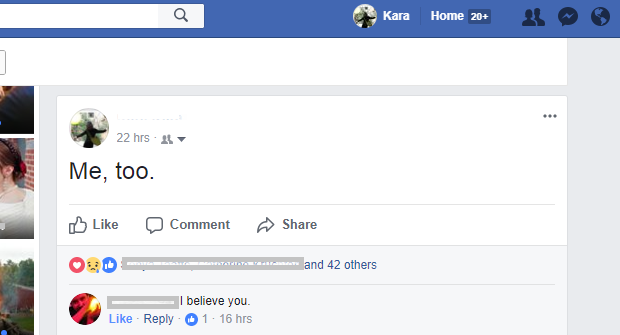
But here’s the good news: Yesterday’s movement was an excellent first step, as was the #IBelieveYou hashtag that people were posting in response. As the sheer volume suggests, sexual harassment and assault are appallingly common — across generations, across socio-economic status, across orientations, and across the gender spectrum. Silence is a necessary component of system navigation for sexual predation; a problem that isn’t identified cannot be fixed. It’s just that silence is not the only component.
So what are we doing from here? Now is a great time to turn social momentum into social action. But that’s easier said than done, especially when it’s so unclear what people can be doing to help! So here are some modest, concrete suggestions on how to do that:
Learn How to Become an Active Bystander. This one is on all of us, but it’s especially anyone who is placed in the role of a bystander to violence — people who are observing a casual interaction take place, especially in less high-stakes social contexts. (A friend of mine observed that he wasn’t sure how to handle violence in inherently power-stratified environments like the workplace, which is a very fair observation, and I’ll get to that below.) The potentially helpful role of bystanders, especially in instances of sexual violence, is verywell–documented — and so is its corollary the bystander effect, which by definition helps perpetrators maintain a status quo. The National Sexual Violence Resource Centermaintains a resource list and information packet for learning how to be an active bystander, as does Partners to Social Change and RAINN. Take some time to read up on what concrete actions are helpful to others in dangerous situations!
Learn How to Talk to Survivors. Statistically speaking, you probably know somebody who is a survivor. It’s a good idea to learn emotional first-aid generally in our current political landscape, but at minimum, it’s a great idea to take a few minutes to reviewresourcesuggestions on how to navigate assault situations specifically so that you know how to handle it when someone discloses this history to you. (The good news is, if you said “I believe you” yesterday, you are already doing a very important piece of this!)
Learn to Spot Attempts to Enlist Assistance to Violence. A systemic structure of sexual violence (or any structure of violence, honestly) relies on complicit assistance from everyday people. Those people are not monsters; they’re just people who aren’t aware what’s up and can be enlisted as tacit support as a result. And sometimes it’s not possible to speak up without taking on substantial risk, especially in our current environment, but you should always be making that conscious choice instead of just not noticing when your silence is taken as support. Take yourself out of the pool of people who are accidentally helping whenever you can — learn to recognize instances where your supportis beingenlisted indirectly through social interaction. This can be in big ways, but it can be in little ways, too — the stereotypical “women, amirite?” phrase exists for a reason; it’s building consensus and reinforcing the beliefs held by the speaker. No, that person is not right, and it’s okay to tell them so!
Go Forth and Do the Things You Learned in the Wild! Listening is an important first step, and learning is an important second step, but ultimately these things are building towards action. Now is the time to put the things you learned into practice when it’s practicable to do so — which is uncomfortable and it sucks, but not as much as people getting assaulted. Several of the resources listed above have concrete suggestions and steps for how to handle specific situations. It’s really, really valuable and important to spend some time figuring out how to integrate them.
Call Your Reps, Call Your Reps, Call Your Reps, Reps, Reps. A lot of the systemic changes happening right now are on a giant scale, and that’s big and scary and awful. But it also means that you can help by simply exercising your civic rights as a citizen on issues of policy. Stay attuned to issues like coverage changes to the ACA and the abortion bill in the House, and call when you can. If you can’t call, use resistbot to text faxes. If you can’t do either, stay informed. These things might feel like they aren’t related but they really, really are.
I have about a billion other thoughts on this topic, and I might ultimately say more, but for now, I think I’ve hit the major highlights. Thank you for paying attention and join the conversation, and please stay in the fight! We need to all participate if we’re going to build a better culture.





 National News Roundup