In my opinion, the main story about the State of the Union last night is how utterly trivial the State of the Union was – the biggest takeaway the press can collectively come up with is that it was the longest State of the Union in recent history, clocking in at 100 minutes. (That is 100 minutes longer than anyone should listen to that man bloviate.)
Several nouveau and some classic reminders still apply: we may be beginning my tenth year of journalism, but I focus on national news within my areas of expertise–which, at this point, includes (1) health news, (2) queer news, (3) news about law and government, (4) news about descent into authoritarianism, and (5) connections between news stories. At this point, NNR summaries will merely toe-dip into other topics, if that–we are committed to a focused and sustainable format. And, of course, for the law things you read here, I’m offering context that shouldn’t be considered legal advice. Okay, I think that’s about it for the disclaimers. Onward to the news
Chinga La Migra
Image unnamed and licensed to the public under the Creative Commons Attribution-ShareAlike 4.0 International License
Detention Dystopia. Hello, and welcome to the part of the NNR where I remind you just how bad things are with the U.S. detention system again. The administration broadened ICE “authority” this cycle to detain refugees who delay seeking a green card–an incredibly unhinged proposal even by this administration’s standards. Just to remind folks, definitionally, refugees are severely traumatized people who have entered the country legally after an extremely rigorous process, specifically because it is not safe for them personally to be in their home country. This would be bad enough, but it’s rendered even more malicious when you remember that this administration also stopped issuing green cards for any applicants from many different countries at the end of last year. And all of this is accompanied by increased stories in the news about ICE buying warehouses to create detention “mega-centers,”which presumably is where they plan to put all of these legally-present people. Thankfully, there were also some stories about locations that successfully blocked ICE from doing any such thing, and apparently some Dems in Congress plan to introduce a bill to block it as well.
Spotlight on ICE (again, still). There are yet again a lot of ICE-related stories this cycle, although admittedly some of them highlight just how fed up most of the country is. A former ICE instructor made news when he disclosed that the agency has systemically removed many much-needed guardrails from its onboarding process, including screening protocols and hundreds of hours of mandated training. There was another federal opinion about ICE illegally denying opportunities for release and holding detainees past when legally allowed–a process which is likely now easier because so many of the country’s immigration judges have been fired in the past year–NPR reports that two immigration courts have no judges at all. There is also a lawsuit being brought to make CBP stop pressuring unaccompanied minors to self-deport. Against that backdrop, it’s hardly surprising that New Jersey introduced the FUCK ICE Act and Chicago’s denizens chose ‘Abolish Ice’ as the name of their new snowplow.
Image unnamed and licensed to the public under the Creative Commons Attribution-ShareAlike 4.0 International License
Recent Judicial Resilience. With so much of the country’s court systems being broken, it’s easy to forget how much the courts still impede the administration. We got a reminder of this over the past week when the Supreme Court decided to strike down Trump’s tariffs, leaving the administration fumbling and Trump himself spewing vitriol. Though they are attempting to impose new ones, it’s likely those will quickly be paused as well, and in the meantime everyone from Fed Ex to Costco is demanding refunds. And on the other side of the bench, a grand jury in DC refused to indict several federal Congresspeople who told troops they should ignore illegal orders. These glimmers of functionality matter, because they slow down or eliminate pieces of authoritarianism and buy time for longer-term strategies.
So that’s what I have for you this cycle, and I’m sorry, there are still no news refunds. For making it through, you deserve this unusual fetch session and a less corrupt government. I’m still figuring out sustainability, and I would love feedback in the National News Roundup ask box, which is there for your constructive comments. Send me questions! Send me feedback! Send me more hours of sleep!
Yes, you read that right–we’re now entering our tenth year of this song and dance. Things nobody tells you about your thirties, partial list: That you’ll run a weekly accessible news digest for literally all of them. Adulting, amirite?
Several nouveau and some classic reminders still apply: we may be beginning my tenth year of journalism, but I focus on national news within my areas of expertise–which, at this point, includes (1) health news, (2) queer news, (3) news about law and government, (4) news about descent into authoritarianism, and (5) connections between news stories. At this point, NNR summaries will merely toe-dip into other topics, if that–we are committed to a focused and sustainable format. And, of course, for the law things you read here, I’m offering context that shouldn’t be considered legal advice. Okay, I think that’s about it for the disclaimers. Onward to the news
Chinga La Migra
Image unnamed and licensed to the public under the Creative Commons Attribution-ShareAlike 4.0 International License
‘Toddler Supermarket Tantrum,’ taken with permission from Stockcake.com
Establishment vs Press. Former CNN anchor and investigative journalist Don Lemon was arrested for covering a protest at a church in Minnesota earlier this month–even though a magistrate threw out the administration’s attempt to issue misdemeanor charges, Bondi got a grand jury to indict him on nebulous felony charges. For context it’s very rare for a magistrate judge to refuse to issue a misdemeanor charge. In this case, it likely happened due to overwhelming evidence that this famous news person was exercising his First Amendment right to do news things about a developing story. (It turns out, when you’re an investigative journalist covering something,you often film the whole thing, and also tell the camera that you’re there covering something.) Folks, I’m sure many of you reading already know this, but I seriously cannot overstress just how unusual and disturbing this story is.
Image unnamed and licensed to the public under the Creative Commons Attribution-ShareAlike 4.0 International License
Bad Bunny’s Superbowl Halftime Show. I am genuinely not kidding when I say that Bad Bunny’s Superbowl halftime show will help you push back the abyss for a little while–it was an incredible piece of activism. Yes, his set was entirely in Spanish, but I promise that it’s accessible and moving even if you don’t speak una palabra of the language. (Also, Lady Gaga pops up in the middle to sing some English at you.) It has compassion, it has joy, it even has a couple getting married (for real!) in the middle of it. Seriously, just go watch it. And then look up all of the cultural references that he and his consulting historian managed to squeeze in.
So that’s what I have for you this cycle, and I’m sorry, there are still no news refunds. For making it through, you deserve this daring dear rescue and a less corrupt government. I’m still figuring out sustainability, and I would love feedback in the National News Roundup ask box, which is there for your constructive comments. Send me questions! Send me feedback! Send me more hours in the day!
Minneapolis has been on most of our minds this month, for good reason. But the stories coming out of there are so big, that it can be hard to see how they interconnect. We’re going to spend some time looking at how this cycle’s stories link together–not because it makes the stories any easier to stomach, but because it’s important to see the bigger picture.
Several nouveau and some classic reminders still apply: we may be closing out my ninth year of journalism, but I focus on national news within my areas of expertise–which, at this point, includes (1) health news, (2) queer news, (3) news about law and government, (4) news about descent into authoritarianism, and (5) connections between news stories. NNR summaries may still occasionally contain some detailed analysis that’s outside my expertise–I’m a lawyer, not SAMHSA funding!–but we are moving away from this model in general, as we pioneer a more focused and sustainable format. And, of course, for the law things you read here, I’m offering context that shouldn’t be considered legal advice. Okay, I think that’s about it for the disclaimers. Onward to the news!
Nightmares in Minneapolis
‘‘RoboKruger’ by Si2productions, released to the public domain by its creator
Targeting Political ‘Enemies’ (Minneapolis Edition). We’ve already discussed this administration’s horrifying occupation of Minneapolis above, but one aspect that doesn’t get as much air time is their ‘investigation’ targeting Tim Walz, the current governor of Minnesota, and Joseph Frey, the current mayor of Minneapolis–which then escalated to a grand jury for several other MN officials. They join a long list of political figures who are being threatened via federal investigation; the list also includes several Congresspeople, Federal reserve chair Jerome Powell, and New York Attorney General Leticia James.
Ways to Weather This
Image unnamed and licensed to the public under the Creative Commons Attribution-ShareAlike 4.0 International License
So that’s what I have for you this cycle, and I’m sorry, there are still no news refunds. For making it through, you deserve this beaver eating cabbage and a less corrupt government. I’m still figuring out sustainability, and I would love feedback in the National News Roundup ask box, which is there for your constructive comments. Send me questions! Send me feedback! Send me responses to Out: The Community Survey!
Several nouveau and some classic reminders still apply: we may be well into my ninth year of journalism, but I focus on national news within my areas of expertise–which, at this point, includes (1) health news, (2) queer news, (3) news about law and government, (4) news about descent into authoritarianism, and (5) connections between news stories. NNR summaries may still occasionally contain some detailed analysis that’s outside my expertise–I’m a lawyer, not an Epstein file!–but we are moving away from this model in general, as we pioneer a more focused and sustainable format. And, of course, for the law things you read here, I’m offering context that shouldn’t be considered legal advice. Okay, I think that’s about it for the disclaimers. Onward to the news!
Spills in Aisle 47
‘Toddler Supermarket Tantrum,’ taken with permission from Stockcake.com
Image unnamed and licensed to the public under the Creative Commons Attribution-ShareAlike 4.0 International License
Stay Human, Shape Tomorrow. This isn’t the first time I’ve pointed folks towards Paul Shattuck‘s excellent writings on what he calls Strategic Humanism, and I’m sure it won’t be the last. This particular cycle, I want to draw attention to a recent post about what he calls “circuit-breakers” for doom scrolling–a useful skill for basically all of us when something bombastic like this past news cycle happens. HIs post has a good amount of more specific information, but in essence, he talks about a combination of ways to take breaks with intentionality and ways to ground yourself in your current place and time. If you’re in a hurry, here are some concrete suggestions he gives:
Look away from your screen and name five objects in the room.
Turn off your phone and put it in a drawer for one hour.
Set a 3-minute timer and step away.
Pick one corner of your physical space and restore it for two minutes.
So that’s what I have for you this cycle, and the wait did not improve anything. For making it through, you deserve Minion’s opinions and a less corrupt government. I’m still figuring out sustainability, and I would love feedback in the National News Roundup ask box, which is there for your constructive comments. And, of course, I would be remiss if I didn’t mention that my org’s handy-dandy survey measuring health throughout 2025 will be live until 1/31, and it only takes a half hour of your time to make the science go. Send me questions! Send me feedback! Send me responses to Out: The Community Survey!
I’m going to be honest, I found this cycle particularly nightmarish. Granted, I’m a public health professional, and our health system took a real beating this week–but the other stories aren’t a whole lot better. Caveat emptor, and I’m sorry in advance.
Several nouveau and some classic reminders still apply: we may be well into my ninth year of journalism, but I focus on national news within my areas of expertise–which, at this point, includes (1) health news, (2) queer news, (3) news about law and government, (4) news about descent into authoritarianism, and (5) connections between news stories. NNR summaries may still occasionally contain some detailed analysis that’s outside my expertise–I’m a lawyer, not a healthcare subsidy!–but we are moving away from this model in general, as we pioneer a more focused and sustainable format. And, of course, for the law things you read here, I’m offering context that shouldn’t be considered legal advice. Okay, I think that’s about it for the disclaimers. Onward to the news!
Spills in Aisle 47
‘Toddler Supermarket Tantrum,’ taken with permission from Stockcake.com
Image unnamed and licensed to the public under the Creative Commons Attribution-ShareAlike 4.0 International License
Chop Wood, Carry Water. I was recently pointed towards Jess Craven’s Chop Wood, Carry Water by the inimitable Tegan Kehoe, who featured the substack in a recent Links and Things from Tegan (alongside the NNR, which I greatly appreciated!). As Kehoe notes, Craven sends a brief newsletter every weekday with some information about recent national news. That said, I’m featuring Chop Wood, Carry Water here because she also includes tools for taking action about those stories, such as scripts for calling your reps and information about upcoming events. Like me, Craven is a full-time activist and advocate, and so far I have really appreciated her work.
So that’s what I have for you this cycle, a day late but only $0.25 short. For making it through, you deserve this raccoon’s self-care regimen and a less corrupt government. I’m still figuring out sustainability, and I would love feedback in the National News Roundup ask box, which is there for your constructive comments. Send me questions! Send me feedback! Send me responses to Out: The Community Survey!
This cycle was a weird one, y’all–even setting aside the weirdEpsteinfileabout-face and MTG’smud-slingingresignation, there’s a lot to unpack here. The news felt a bit like living in 2017, if 2017 involved more overt death threats. Ah, memories.
Several nouveau and some classic reminders still apply: we may be well into my ninth year of journalism, but I focus on national news within my areas of expertise–which, at this point, includes (1) health news, (2) queer news, (3) news about law and government, (4) news about descent into authoritarianism, and (5) connections between news stories. NNR summaries may still occasionally contain some detailed analysis that’s outside my expertise–I’m a lawyer, not an indictment!–but we are moving away from this model in general, as we pioneer a more focused and sustainable format. And, of course, for the law things you read here, I’m offering context that shouldn’t be considered legal advice. Okay, I think that’s about it for the disclaimers. Onward to the news!
Spills in Aisle 47
‘Toddler Supermarket Tantrum,’ taken with permission from Stockcake.com
The Prosecution Rests (on Nothing). James Comey had a good time this week, and honestly, I love that for him. First on Wednesday, the Justice Department admitted that the grand jury never saw the final version of the indictment they allegedly approved. That’s a prosecutorial no-no and probably grounds for dismissal all by itself (though the judge on the case didn’t agree). But then just today, a different federal judge dismissed the criminal charges against both Comey and Leticia James on the incredible grounds that the lead prosecutor Lindsey Halligan was not a valid U.S. attorney in the first place. It was a dismissal without prejudice, so I’m sure we haven’t heard the end of this, but let’s enjoy dunking on Lindsey Halligan while we can.
Death Threats and Deployments. This story, ye gods. Okay, so, several sitting Democrats with military and intelligence experience made a video last week and posted it on Facebook. The video reminded current military and intelligence personnel that they can, and should, refuse illegal orders. Trump, meanwhile, immediately illustrated why they needed to make said video, by going on Truth social and yelling that making the video was–and I quote here–“punishable by death.” Now several of said reps are requesting a police investigation into our current President, on account of he made unhinged posts threatening to hang them. Meanwhile, the Pentagon is going after another of the six, Senator Mark Kelly, who is the only one still subject to potential court martial as a retired officer. As if underlining the point, while all of this was going on, a D.C judge granted an injunction to make Trump stop deploying the National Guard there because–shock of shocks–it’s probably illegal. And the Coast Guard was in the news for deciding that swastikas and nooses were not hate symbols anymore (though in fairness, the Coast Guard did walk that one back pretty quick after everybody rightfully got in their face about it).
Image unnamed and licensed to the public under the Creative Commons Attribution-ShareAlike 4.0 International License
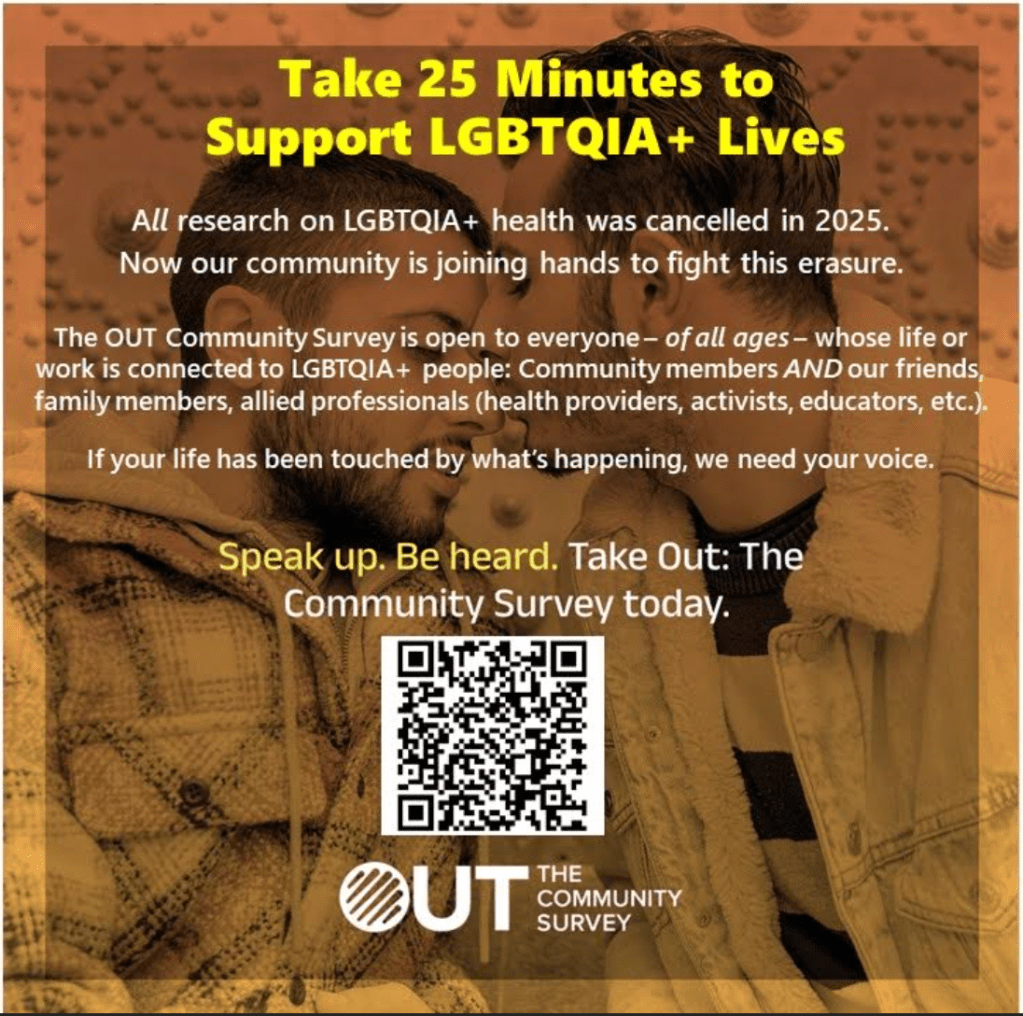
OUT: The Community Survey. Some of you have heard me talk about this effort before, but I’m really excited to say more about it here–I’m leading international volunteer work right now that I really believe will help LGBTQIA+ lives long-term. A week and change ago, my organization officially launcheda study to get more info on how queer people’s lives have changed since the U.S. Inauguration, and what the current levels of oppression are doing to our health and safety. Right now, and for ten more weeks, we’re hosting an anonymous community survey to measure that.
It’s open to everyone fifteen and older who identifies as LGBTQIA+ or loves someone who does, throughout the entire world. There is no payment or personal benefit of any kind connected to this survey, and we plan to make the results publicly available. It’s rooted in the simple idea that if we know what people need, we know how to advocate and how to meet this moment for our communities. I mention this under the ‘Ways to Weather This’ section because I truly believe that it’s a form of resilience to share what you are going through and to connect with others about your health and emotional safety. But also, we want it to reach as many people as possible, and we’re relying on volunteer partners and word-of-mouth to get the word out.
If you’re reading this, I urge you to share how this moment is affecting you by taking the survey; we’re also still looking to partner with people and groups who have interest in spreading the word. Please feel empowered to forward the link and these materials, and if you have any interest in partnering, give me a quick ping and we’ll make that happen.
So that’s what I have for you this cycle, and boo on this cycle for making me kind of miss 2017. For making it through, you deserve this pupper’s learning journey and a less corrupt government. I’m still figuring out sustainability, and I would love feedback in the National News Roundup ask box, which is there for your constructive comments. Send me questions! Send me feedback! Send me more hours in the day!
Let’s face it: As we’re navigating The Trashfire National Policy of 2017, we’re all getting traumatized — it’s tough to get used to that dull-roar screaming we all hear every time our illustrious President vents his spleen on Twitter. And many of us have other stressors in our lives that are making it even harder to navigate, because life does go on even in the face of an abusive relationship with our government — and life is hard. And all that is before we consider the very real practical realities of living without necessities like food or water, or living without healthcare, or living in fear of physical attacks. In the wake of this weekend of introspection, I’ve had many conversations with folks about how to live instead of just surviving, and in some cases simply about how to survive.
So I’m taking off my lawyer hat for a moment, and putting on my trained clinician hat, to talk to y’all about how to deal with trauma. And to begin this conversation, we need to start with a simple truth commonly understood by first-responders everywhere, and borne out by research: Trauma is aformofinfectioustoxin. You have to clear it out in order to get healthy, and staying healthy will help you resist it further, both in your own life and when loved ones’ trauma threatenstoinfectyou. And that’s not to say that we should stop exposing ourselves to toxins, which often isn’t possible and in many cases would be morally reprehensible. Rather, I’m saying the opposite: Becausewe’re all in this toxic soup together, that means we gotta help each other, and to keep doing that we also gotta help ourselves.
So I’m submitting for your perusal a kind of Trauma Resilience Roadmap — concrete suggestions and links to research, separated into three buckets: Do This Immediately, Do This When You Feel Able, and This Will Take Startup Cost But Will Help I Promise. I can’t promise it will fix everything, but it’s my hope that for many people (including myself), it will be a start.
Do This Immediately (or: Emergency Recentering Treatments)
These are the things you need to do when you’re at the stage where you’re asking, “But how do I survive?” Acute crisis mode has its own set of rules, and that can be hard to accept but it’s important to acknowledge. The flip side is that acute crisis doesn’t last forever, and this list will hopefully help you come out the other side.
Stay well-hydrated. It’s such a little thing, but trauma and stress create both physiological effects that can be exacerbated by dehydration (e.g. muscle tensions, headaches) and also creates a bunch of chemical junk in your system that can be flushed out by drinking water really often. Studiesshow drinking enough water really does help, and very quickly.
Give yourself permission to tune (non-essential) things out. Whatever secondary things are stressing you out, and I’m guessing this is a large list, it’s okay and even a very good idea to put it down for a moment or two when you’re in crisis. Twitter will survive a Monday without you. That friend who needs an ear about her mortgage payment can find another one this Tuesday. Obviously, this only works on the stressors that aren’t center-stage right now. But I honestly, truly mean this: It’s okay to be ruthless about random stressors when you’re in crisis.
Start a list of images and activities that always soothe you. This might be hard if you’re in the middle of a huge amount of stress, but even something as simple as “I feel better when I look at otter pics” and then looking at some otter pics can buy you a tiny bit of cope (which I’ll colloquially refer to here as “cope points”), and that can be pointed towards a larger and more permanent form of help down the road. Don’t aim for an exhaustive list right now; just list the stuff that you immediately think of as bringing you joy and comfort, with a bias towards things you feel able and ready to do right this moment. And if you know things that you don’t feel able to do right now but always help (e.g. going hiking, mindfulness exercises, book-binding), go ahead and put them on the list. But don’t try to do them right now; they’ll still be there when we get to Phase 2.
Accept (even trashy) activities that help you tread water. For me, this happens to be inane phone games — they take up my whole screen and block out social media, which means I’m definitely tuning things out as I play (and also, match-3 games are really satisfying for me; I have no idea why). It might be eating junk food for you, or watching really crap television, or reading truly awful fiction novels — things that if you were doing well might make you think “I’m judging myself for doing this right now,” but aren’t actively destructive or harmful. This can also be low-cost things that you’re less likely to be self-judgy about (e.g. watching really good television, eating delicious salads, reading excellent literature) but hopefully you started doing those already with Item #3. If you aren’t, you should let yourself do those things in your spare moments. If you are also doing Item #2, you have more spare moments to do them. 🙂
Here’s a sample beginner list:
1) Watch my favorite movie;
2) Read some really awful fanfic;
3) Look at cat GIFs on the Internet;
4) Cookiepalooza;
5) Play Rock Band
Do This When You Feel Able (or: Convalescent Recentering Activities)
These are the things you need when you’re at the stage where you’re asking, “How do I live instead of just surviving?” It’s my guess that after nine months of President Cool Ranch Mussolini, most of us are who aren’t in immediate crisis are hanging out at this stage. It’s the trauma equivalent of being stuck in bed with a stomach bug yelling “but I wanna eat tacos!” — we’re all well enough to miss things, but not well enough to have them yet. This part of the primer is the transition from “I can’t get out of bed” to achieving your taco-nomming dreams.
Stay well-fed. This one can be hard for people in the middle of crisis, for about a million reasons. But once you’re feeling okay enough to pay attention to it without feeling like OH MY GOD A MILLION THINGS I CANNOT EVEN, good food hygiene is an incredibly valuable foundation for mental health; there are lotsandlotsofstudiesthat show that people who are experiencing trauma are less able to adhere to good food hygiene and also suffer more when they can’t. If you’re a person who has trouble eating when stressed, “good food hygiene” can look like “I ate some Cheetos at midnight before I fell asleep in an orange-coated haze” as long as other, more nutritious calories happened also — it doesn’t literally mean “only eat things that are good for you;” it means “put calories in your system on a regular basis so that a blood sugar crash doesn’t happen on top of everything else.” (Long-term daily Cheeto binges might lead to other problems, obviously, but we’re talking short-to-medium-term here.) Some people do have the opposite reaction to stress, and stress-eat everything in sight; for those people, good food hygiene might look more like “pause and evaluate whether I feel hungry before I put this thirty-first food item in my face.” (Note that we’re discussing common immediate stress reactions to food rather than systemic eating disorders, which obviously have their own set of rules and treatments.)
Get enough sleep. This is basically the same as the notes above — goodsleephygiene is a tremendously helpful foundation for mood. But this one is super hard to do if you’re not doing well; I personally find it about a million times harder than shoving food in my face when I’m too stressed to be hungry. For me, optimizing sleep hygiene looks like skipping that third cup of coffee (unless I really need it), taking a melatonin pill before bed, and hoping I don’t have nightmares. Your mileage may vary. But in general, the more other forms of decompression help, the more sleep stops being an elusive beast and becomes a regular part of life again. And that’s a really important step for resilience.
Ride the Hygiene Horse generally. There is absolutely zero shame in forgetting to brush your hair, skipping a shower, or otherwise forgetting a regular daily hygiene thing when you’re in immediate crisis — in fact, it’s a common symptom that something is very wrong. But once you’re out of crisis mode, it’s super easy to start being angry with yourself for forgetting things — or doing the opposite, and feeling like you just don’t have the energy for tasks like showering. (Or both. Some lucky people experience both.) But once you’re in “I feel ready to eat and sleep normally” mode, it’s a good time to make sure you’re keeping ordinary hygiene habits all around. They help, and they matter, and not doing them long-term can affect mood and keep you in a dark place.
Make a more complete, long-term list of recentering and joyful things. Once you feel able, make a comprehensive list of all the things that bring you joy and help you feel More Able to Even after you do them. Hopefully, most of the things that are really easy (e.g. “Look at doggo pics,” “Reread my favorite novel,” “Eat Cheez-Its”) are already on your list, but this is a good time to add the less low-hanging fruit — things that you know help but didn’t feel approachable in the middle of crisis. It’s also a good time to spend an hour or two really thinking about what brings you joy and comfort — and if you feel able, take your best guess at what is an easy thing, what is a medium thing, and what feels like a hard thing right now. You may or may not feel ready to do all these things (and my guess is some of them will feel super far away), but making a list of them helps you prep and move forward for when you do feel ready. And some of them might feel within reach, which can give you back extra cope!
Try simple meditative activities (that aren’t literal meditation). A friend of mine mentioned meditative coloring today, which honestly is a really good low-cost meditative activity. Some people find cleaning to be stress-reducing when they’re at this stage. If you’re like me and find repeatedly stabbing things really satisfying when stressed, embroidery is pretty great. The goal is to aim for things that give you a quick cope point in the moment, don’t eat more than maybe one cope point to set up, and then give you an extra cope point when you can look at them later and think “Look what a productive thing I did!” But at this stage, easy activities that you know how to do and feel comfortable doing mindlessly are best. Bonus points if they’re also on your list. (Also, this is a great way to slowly expand your list! 🙂
Here’s a sample second-stage list:
1) Easy activities — I’ve been doing these all along:
Watch my favorite movie; Reread my favorite book; Look at cat GIFs on the Internet; Eat Cheez-Its; Play Caves of Qud
2) Medium Activities — try some of these if I can:
Embroidery projects; Meditative coloring; Clean my workspace; Read nonfiction; Cook more meals
3) Hard Activities — I’m not ready for these yet:
Learning book-binding; Going on regular hikes; Working on my novel; Going to the gym regularly
This Will Take Startup Cost But Will Help, I Promise (or: Long-Term/Preventative Recentering Activities)
These are the things that you want to keep in your life as you navigate low-grade ambient stressors (such as hearing 45’s voice on the television as he discussed tax reform) — it’s for when you’re feeling well enough that you should no longer be tuning out the white noise that accompanies an inherently traumatizing atmosphere. We owe it to ourselves, and to each other, to do what we can to stay engaged but healthy as we all walk through this nightmarescape. Here are my modest suggestions for how to do that when you’re not in crisis.
Get out of the house on your own terms. Meet a friend at a bookstore; go for a walk; get some coffee from that awesome cafe you haven’t been to in a while. Something that requires physical movement, brings you joy, and feels like the opposite of retreating or withdrawing. It’s super-important, by the way, that this be a thing that you are doing for yourself and on your terms, rather than because someone dragged you or guilted you into it. It’s not going to be useful for decompression if you’re being dragged (and you’re not the one doing the dragging).
Try some of the stuff marked ‘hard’ on your recentering list. Try your hand (see what I did there?) at watercolor, or some other task that you know brings you joy but has felt far away lately. Don’t be angry with yourself if it doesn’t quite click; these are things that take cope to give cope, and it just means you didn’t have the cope for them yet. Go back to some of the easier tasks and do those — you’re still healing, is all. But if the thing brings you joy and feels net-positive, it’s a really helpful marker for knowing where you are in this process. Plus you got to do a thing that brings you joy! (Note: Now is also the time to purge the list items that you felt kind of mixed about or would be harmful to rely on too long in the long-term.)
Try more complex meditation. Some people find going to the gym really meditative. Some people get a lot out of traditional mindfulness meditation, such as guided meditation or progressive muscle relaxation exercises or something similar. I’m partial to singing-based meditation. But basically, this is the time to try varying simple tasks that are meditative through repetition (e.g. coloring, sewing) with activities that are meditative in a more traditional sense. There are lots and lots of studies that show that meditation can be extremely helpful to people for stress resilience, but trying to do it when you’re still actively processing toxic trauma is really hard.
Consider setting up a therapy appointment. There is seriously zero shame in setting up an appointment if you think about it carefully and decide you need one. There’s also zero shame in deciding it’s not right for you. Basically, just a good thing to evaluate at some point — people see an eye/nose/throat doctor if they’ve had a sore throat for forever; people should also see a therapist if something has been wrong with their stress or trauma levels forever.
Evaluate what stressors you are managing. Some stressors (e.g. natural disaster, getting sick, jerks on public transit) are not avoidable, and will always require navigation and detoxification. Some (e.g. a romantic partner wanting to spend time with you) are stressors when you aren’t doing well, but are either positives or neutral things when you are doing better. And some (e.g. that one friend who wants you to loan them $20 literally every day) are literally always stressors and never necessary to navigate. Figuring out long-term planning for stressors, and how to set boundaries for the random white noise you just super don’t need, takes energy but also is generally a really good step for health. Approaching stressors with intentionality can both help you gate-keep and also give you a sense of control over your situation.
Keep doing all the things on the convalescing list. We don’t stop needing the things that bring us joy when we’re no longer in crisis; in fact, ability to do the things that bring us joy is arguably what it means to be living rather than surviving in the first place. And things like good food/sleep/personal hygiene and staying hydrated stop being optional when we’re constantly taking in stress.
View your stressor intake and decompression as an equation that needs to be balanced. You can take in more stressors when you have more in place to center you. You can take in fewer stressors when something major is going on — be it crisis, chronic limitations, or something else. At the end of each day, this equation needs to balance, or burnout, depression, and disengagement can occur. And that’s an outcome nobody wants, or even should want.
The reality is that most of us will yo-yo between these three stages as new horrors crop up and create new crises — it’s like a morbid game of Chutes and Ladders that we play with our mental health instead of meeples. And when something serious happens, and you have to go back to the beginning of the roadmap, that’s okay — being able to identify and acknowledge current stage of crisis, and current level of trauma, won’t fix everything. But it’s an important set of tools that we can use to support ourselves and each other. We can get through this, and we will. It’s my hope that this roadmap will help.





 National News Roundup